No products in the cart.



10 min read
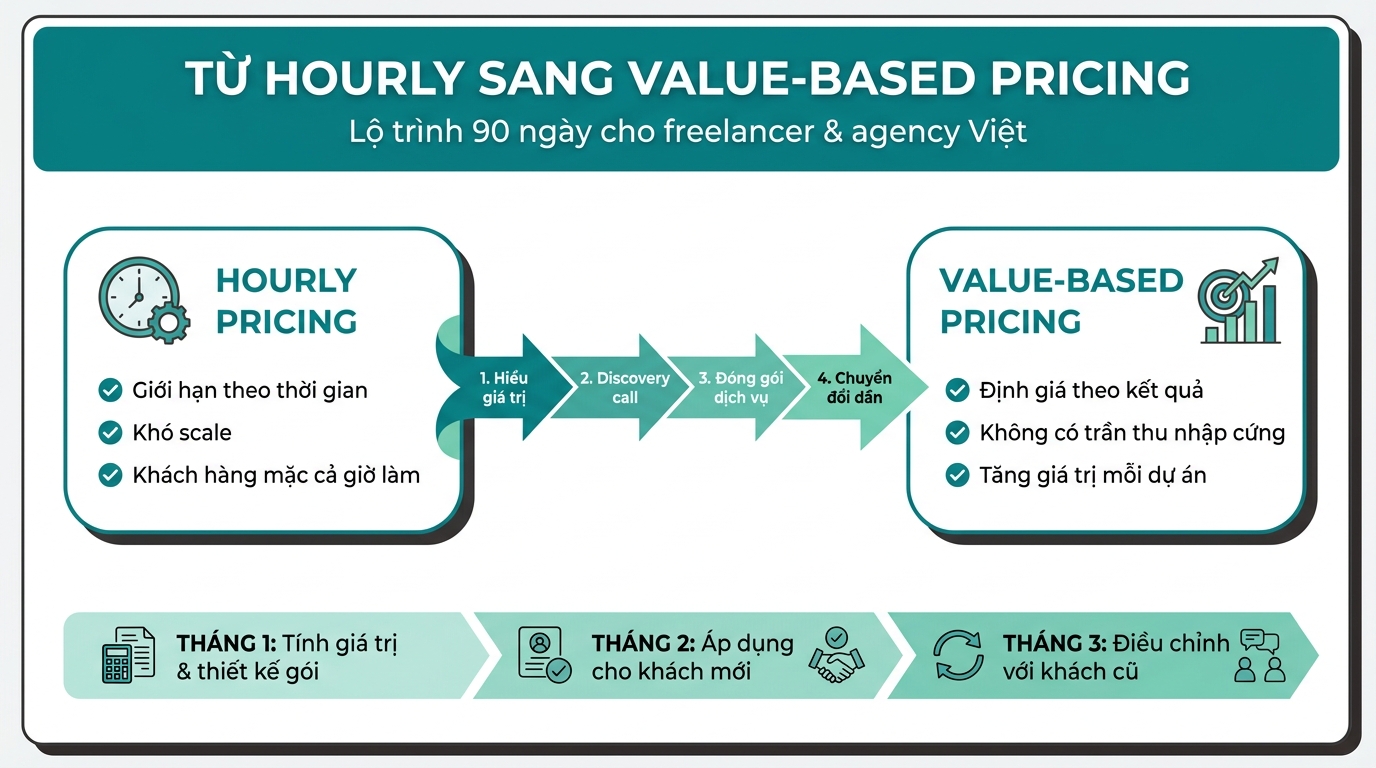
Short answer: Value-based pricing charges clients based on the results you deliver, rather than the time spent — helping freelancers and agencies break through the income ceiling imposed by hourly pricing. 4-step roadmap: measure the economic value created, conduct discovery calls correctly, package services based on results, and transition existing clients within 90 days. Start with new clients immediately, keep existing ones until renewal.
Many freelancers and agencies choose to charge by the hour because it feels transparent and easy to explain. The client asks “how much do you charge?”, and you reply “X thousand per hour” — simple, clear. But this simplicity hides a fundamental paradox: the more skilled you are, the faster you work, and the less you earn. An experienced writer can complete a quality blog post in two hours, while a newcomer needs a whole day — if both apply the same hourly rate of 300,000 VND, the more experienced person, who creates more value, earns less. This isn't their fault. It's the fault of the model.
Article contents
Hourly income is strictly limited by the amount of time available in a day. Even with a rate increase, you're still selling a limited resource — and customers always tend to negotiate to reduce the number of hours. When wanting to expand, the only solution is to hire more people — meaning increased costs, complexity, and management risk.
Value-based pricing approaches the problem from a completely different angle: instead of pricing based on time spent, you price based on the results the client receives. This shift in thinking — though simple — changes the entire way of operating: from how you converse with clients, to how you package services, to how you measure business success.
“Price is what you pay. Value is what you get.”
— Warren Buffett
| Criterion | Hourly pricing | Value-based pricing |
|---|---|---|
| Pricing basis | Time spent | Results and value created |
| Income ceiling | Fixed based on hours | No hard limits |
| Risk of being cut back | High — clients always want to reduce hours | Not applicable when scope is clear |
| Encourages efficiency | No — taking longer means more money | Yes — solving quickly still yields full payment |
| Main challenge | Hard to scale, dependent on time | Need to deeply understand the client's problem |
| Most suitable for | Work that can't be measured by output | Services with measurable results |
Summary: Hourly pricing is only suitable in two cases — when you're starting out and haven't determined your value, or when the work truly can't be packaged based on results. In all other cases, value-based or hybrid (retainer + performance) pricing yields higher income and more sustainable client relationships.
Before quoting based on value, you need to know what that value is — not based on intuition, but on specific numbers. How much do your services help clients increase revenue, save costs, or free up time equivalent to how much money?
Take a real-life example: an SEO agency helps a client increase traffic from 2,000 to 10,000 visits/month. With a 2% conversion rate and an average order value of 500,000đ, the additional 8,000 visits generate approximately 80 million in revenue per month. At an SEO cost of 20 million, the client's ROI is four times higher — and when they see that number, they have no reason to haggle. First exercise: with your 3-5 closest clients, calculate how much money you've helped them make or save. That number is the foundation for your new pricing structure.
A common mistake when starting to transition to value-based pricing is to still quote immediately at the beginning of the conversation — just quoting by package instead of by hour. This approach skips the most important step: deeply understanding the customer’s problem before proposing anything. A discovery call is not a sales call — it’s a conversation to understand the current situation, expectations, financial gaps, and priority levels in the overall business picture.
Three effective discovery call questions:
Only when you have answers to those questions can you propose a price that truly reflects the value you create. A quality discovery call typically lasts 30–45 minutes — and if the customer is not willing to spend that time, it’s a sign of their level of seriousness.
How you present your services is just as important as the services themselves. When you say “marketing consulting for 500,000 VND/hour, estimated 20 hours”, you're inviting the client into a discussion about time — and you'll lose. But when you say “60-day online marketing channel optimization program, including a comprehensive audit, strategy development, implementation guidance, and two review sessions, with expected results of reducing advertising costs by 30% or increasing conversion rates by 25%”, you're talking about results — the language customers actually care about.
Customers do not pay for your time. They pay to solve their problems. When packaging based on results, you not only sell more easily — you also create a clear distance from competitors who still compete on hourly rates. And more importantly, you regain control over how your work is valued.
A common mistake is to change the entire pricing model at once and apply it to all customers. This approach often causes unnecessary disruption and may lose satisfied customers. Instead, convert in groups: new customers apply value-based pricing from the start without explanation — it’s the default model; existing customers wait for renewal or scope expansion to introduce the new package structure naturally; satisfied customers don’t need to rush — adjust gradually when needs change.
Script for converting existing customers:
“From next month, I’m switching to a service package model instead of hourly billing. For you, this means you know the exact monthly cost and don’t need to track hours. The most suitable package for your current needs is [X] with a fee of [Y]. Would you like me to explain the details?”
All-inclusive pricing for a complete project with a clearly defined scope from the start. Suitable for design, web development, or content writing for campaigns. The most important thing when applying this is to clearly define what “completion” looks like — without that boundary, scope creep will eat into profits. According to a 2023 Freelancers Union survey, 71% of freelancers experience scope creep at least once a quarter when there is no clear SOW.
A fixed monthly fee in exchange for a set of deliverables or predetermined results. Ideal for social media management, SEO, accounting, or periodic consulting — creating a stable income stream and long-term relationships. Reference principle: the retainer should be at least 60–70% of the value of an equivalent project, reflecting the ongoing commitment from both parties and compensating for holding a spot for them.
Receiving a percentage of actual results — a percentage of advertising budget, increased revenue, or leads generated. Suitable for advertising agencies or sales consultants, but carries two-way risk: if results are good, you earn more, if not, you have no income. The most common way to balance this is to combine a fixed basic fee with a performance-based bonus — ensuring minimum costs, with additional benefits shared based on results.
Packaged and standardized services like a product: fixed price, fixed scope, proven process. Suitable for audits, system setup, or starter packages — and can be scaled without proportionally increasing personnel, since the process has been standardized to the point where you or anyone on the team can perform it consistently. This is the most profitable model when applied correctly.
✍ Key takeaways
TEMPLATE COMPANION
Measure value to determine pricing — choose a template by industry
Value-based pricing starts with measuring the economic value you create for customers. The six Excel templates below provide a calculation framework for costs, revenue, and ROI for each industry — to be used as a baseline for discovery calls and proposals.
Language Center
ClassPilot — managing education center operations
Baseline enrollment, retention rate, LTV to quote consulting based on results.
Interior Construction
Interior Fit-out — estimation & cash flow
Fixed project pricing per phase, with a clear SOW to prevent scope creep.
Online Sales
E-com Navigator — profit & cash flow
Measure ROAS, CAC, LTV — the basis for performance-based pricing in agency ads.
F&B / Restaurant
F&B Recipe & COGS — controlling cost of goods
Baseline cost base, margin per dish — working as a retainer consultant with data.
Room rentals
Complete rental property management
Occupancy rate, revenue per room — productized audit for real estate.
Transportation/Logistics
Fleet Trip — managing vehicle fleets & shipments
Cost-per-km, trip profitability — input for performance-based logistics consulting.
No — as long as you deliver the promised results. Clients pay to solve problems, not to buy your time. If they ask, respond confidently: “I can complete it quickly because I've done this many times and have a clear process — and that's also why the results are more reliable.” The confidence in that answer usually dispels any concerns.
This is a real risk that needs to be managed beforehand, not handled afterwards. A thorough discovery call and clearly defined scope are the first line of defense. Building a 20–30% buffer into every estimate — not to charge more, but to have room to handle unexpected situations without affecting quality or the client relationship.
When clients ask “how much per hour?”, they don't really want to buy by the hour — they're just using the most familiar framework to start the conversation. Gently shift the framework: “Instead of hourly, I usually work on a package basis because it's clearer and easier to manage for both parties. Let me understand your specific needs first, then I'll propose the most suitable package.” If the client still wants to see hours, clearly state the estimated hours as part of the scope — but the fee remains package-based.
You should apply a hybrid approach: hourly for the first 3–6 months to build a portfolio and understand which types of work create what value, then switch to value-based when you have 5–10 specific case studies. Applying value-based too early, before measuring the value you create, will lead to incorrect pricing — either too low (reduced profit margin) or too high (lost deal).
Not convincing — reframe. Emphasize their two real benefits: (1) knowing costs in advance, no surprise costs, (2) no need to track hours or argue about “why it took so long”. For business clients, add a third benefit: easier budget approval with fixed costs compared to non-fixed hourly rates. Customers accept quickly when they see value-based as a solution to their problems, not your priority.
Reference: Ronald Baker — Implementing Value Pricing (2010) · Blair Enns — Pricing Creativity (2018) · Freelancers Union — State of Freelance Report 2023 · Warren Buffett — Berkshire Hathaway annual letters
—
Get insights on management, operations & digital assets delivered to your inbox.

Copyright © 2026 BEUP Learning Solutions
MST: 3301755602
Book a free consultation to explore how BEUP can transform your workflow.
Book a Consultation →Digital Asset Ecosystem & Operating System for individuals & teams.