No products in the cart.



7 min read
Short answer: Managing a photography studio with Excel allows photographers to track the entire booking lifecycle, calculate the actual cost of each session (including editing time, equipment depreciation, and travel), and analyze profitability by session type. Photographers who do 10-30 sessions per month don't need expensive software; a well-structured Excel file is enough to identify profitable sessions and make informed decisions about pricing and booking mix.
Most freelance photographers go through a similar phase: a packed schedule, regular clients, but at the end of the quarter, their account balance doesn't match the amount of work they've put in. The issue often isn't the low shooting prices, but rather the failure to account for the true costs of each session — especially the most invisible expense: editing time after the shoot.
Shooting a wedding takes 8 hours, and editing takes an additional 8-12 hours. This second part is not included in the quote, does not appear on the invoice, but it is real time — time that could be used for additional bookings or not at all. By not valuing edit time, photographers are essentially paying themselves 0 dong for the part of the process that takes up the most time.
Without a tracking system, all sessions appear equal on the surface. A 3.5 million dong portrait and a 12 million dong wedding are both recorded as “income”, but their actual profits may differ entirely, often in the opposite direction of expectations.
Article contents
The real cost of a session including: edit time valued at the photographer's hourly rate, travel costs, equipment depreciation allocated per session, and direct costs like album labs or printing. Gross revenue minus all these costs equals the actual profit of the session.
For example, a wedding that earns 8 million dong. Subtracting 7 hours of photo editing at a rate of 150,000 dong per hour gives 1.05 million dong just for editing. Adding 200,000 dong for round-trip travel and allocating the depreciation of a 70 million dong Sony A7IV camera over 5 years (around 1.17 million per month), plus an additional 700,000 dong per month for lenses and flash equipment, each session bears an additional 300,000-500,000 dong in equipment costs.
The actual number from a single wedding, as described above, drops from 8 million to around 6-6.5 million dong before considering any other overhead. This is still a profitable session. But the picture changes significantly when comparing across session types, and this is information that most photographers currently lack.
One of the most important insights when starting to track session costs is discovering the margin difference between portraits and weddings. The initial assumption is often that portraits are quicker, simpler, and less stressful, so they must have better margins. Reality often proves the opposite.
Weddings have a higher absolute price than portraits, but edit time is also longer. What matters is the ratio of edit time to revenue: a 3.5 million dong portrait may require 5-7 hours of editing to deliver the promised number of photos, while a 12 million dong wedding typically requires 8-10 hours. When considering profit per working hour, weddings are often 30-40% higher. Photographers who fill their schedules with portraits because they seem “faster” may be unintentionally choosing lower-paying work.
This doesn't mean that portrait sessions are always less profitable. With a standardized culling and editing process, portraits can still achieve good margins. The problem is that without tracking, it's impossible to know this. Decisions about session mix, pricing, and monthly maximums are being made without foundational data.
Summary: The real profit of each session type can only be compared when considering edit time based on hourly rates, equipment depreciation, and direct costs. Most photographers make pricing and booking mix decisions without this information.
Instead of tracking everything from the start, there are three core metrics that photographers need to understand to make informed decisions about their studio operations.
The first key metric is average real cost per session, broken down by session typeThis is the basis for calculating break-even points when pricing and determining how many sessions are needed per month to reach income targets. Without this number, photographers may take on more work than necessary because they don't know what their limit is.
The second key metric is gross margin % by session typeMargin is calculated by subtracting real costs from revenue and dividing by revenue. With this number for each session type, photographers can see which ones contribute most to their actual profit and adjust their booking mix accordingly.
The third key metric is monthly equipment depreciation vs revenueThis is a hidden cost that most photographers don't factor in. A Sony Full-frame camera kit with two specialized lenses and a flash system can cost between 150-250 million dong, with an average depreciation period of 5-10 years. When allocated monthly, this is a real cost that must be recovered through pricing, but if not tracked, it remains invisible.
A skilled photographer knows more than just how to take great photos. They also understand the true cost of each working hour, which types of sessions are most profitable for their studio, and when to raise prices instead of increasing bookings.
The problem is not that photographers lack information. Information exists everywhere: booking schedules in calendar apps, payment notes in messaging apps, equipment invoices in emails. The problem is that dispersed information has no analytical value. When it's impossible to cross-reference between revenue, costs, and session types, it's impossible to answer any meaningful questions about business efficiency.
The necessary data structure for a freelance studio is simple enough to maintain yet comprehensive enough to make decisions. The booking section needs to track the entire lifecycle from inquiry to final payment, with deposits calculated automatically and warnings for overdue payments. The session cost section needs to be linked via Booking ID so that each session knows its actual costs. The equipment section is entered once and automatically depreciates by month and by equipment type.
When these three components are connected correctly, a comprehensive dashboard can automatically pull data and display gross profit by month, margin percentage by session type, overdue debt list, and performance comparison between periods. There's no need to recalculate manually each time you need to review the numbers. Whenever there's a new booking or a session is completed, just add a row and the numbers will update automatically.
This is the difference between having data and having actionable information. For a freelance studio with 10-30 sessions per month, a correctly structured Excel file is enough to achieve this without needing complex studio management software with monthly subscription costs.
✍ Key Takeaways
PRACTICAL TOOLS
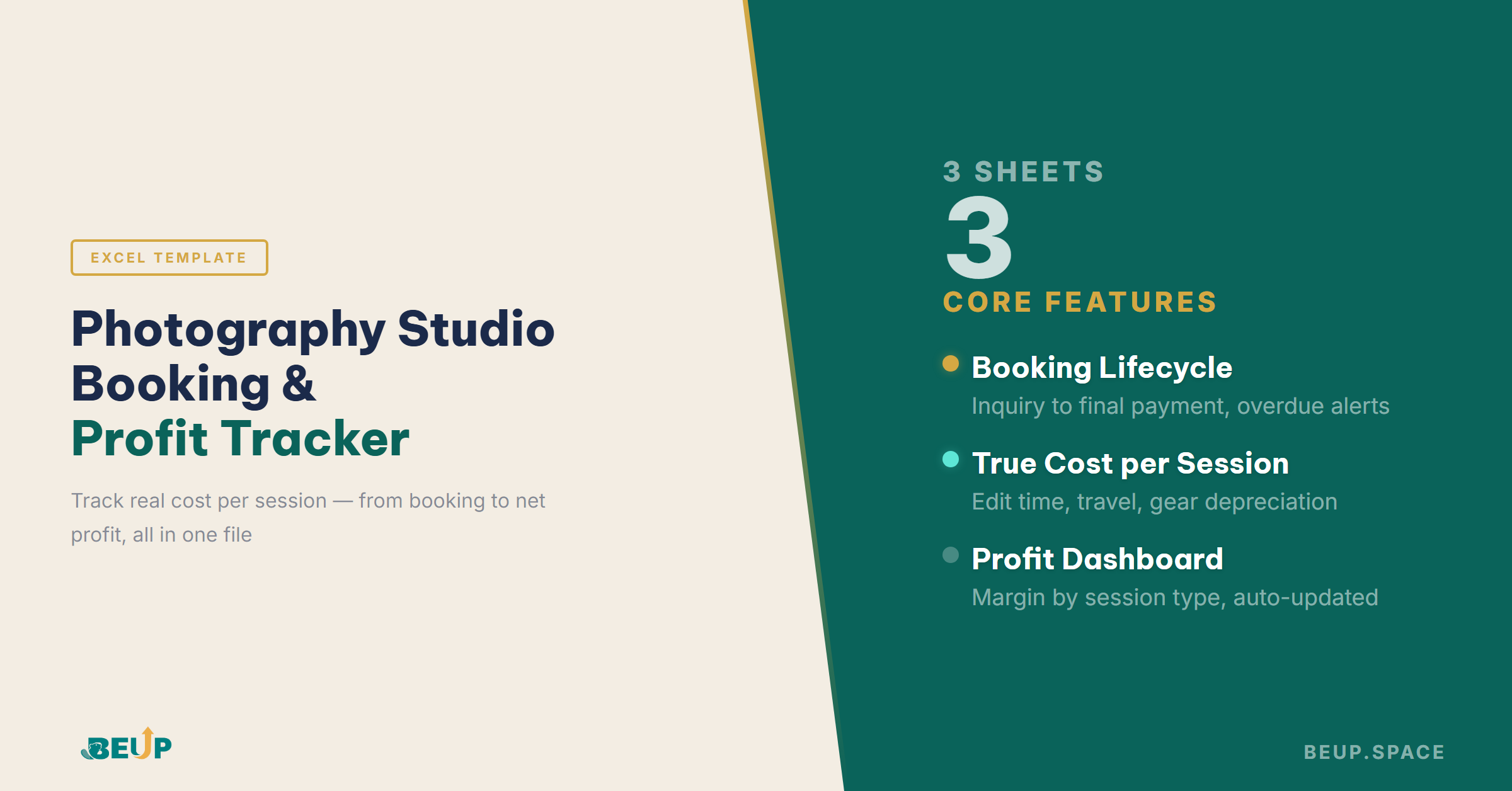
Photography Studio Booking & Profit Tracker
An Excel template to track the entire booking lifecycle, calculate the actual cost per session, and automatically analyze profit by session type. Daily data entry takes less than 3 minutes, and the dashboard updates automatically.
For a freelance studio with 5-30 sessions per month, Excel is sufficient if structured correctly. Professional studio management software like HoneyBook or Studio Ninja is more suitable when the studio has support staff, needs an automatic client portal, or has more complex processes. For a solo studio in the building phase, a subscription cost of $20-40 per month may not have a clear ROI compared to a well-maintained Excel file.
Apply straight-line depreciation: divide the equipment's value by its estimated useful life (camera body 5 years, lens 7-10 years, flash and accessories 3-5 years). Divide by 12 to get the monthly depreciation cost, then divide by the average number of sessions per month to get the allocation per session. Enter this information once into the equipment sheet, and the system will automatically calculate and allocate it.
Because the ratio of edit time to revenue for weddings is often more favorable than for portraits. A 3-4 million VND portrait session may require 5-7 hours of editing to deliver the promised number of photos. A 10-15 million VND wedding typically requires 8-12 hours of editing. When converted to profit after deducting edit time based on the hourly rate, weddings yield a higher profit per hour, 30-40% higher. This is why experienced photographers often prioritize weddings and commercial work over portrait volume.
The actual cost per session includes: edit time converted to money based on the individual's hourly rate, travel costs (gas/vehicle/parking), equipment depreciation allocated per session, and direct costs such as album lab, printing, and assistant rental if applicable. Consistency is necessary throughout the system so that comparison data between sessions is valuable.
When the booking rate exceeds 80% of available time, delivery time starts to be prolonged, or editing quality decreases due to overload, it's more effective to raise prices instead of taking on more sessions. For photographers with data to track margins, this decision is based on specific numbers. Without data, decisions are often delayed due to a lack of clear grounds for changing pricing.
The straight-line depreciation method is used to calculate equipment depreciation, in accordance with the principle of allocating costs by accounting period.
Get insights on management, operations & digital assets delivered to your inbox.

Copyright © 2026 BEUP Learning Solutions
MST: 3301755602
Book a free consultation to explore how BEUP can transform your workflow.
Book a Consultation →Digital Asset Ecosystem & Operating System for individuals & teams.