No products in the cart.



10 min read
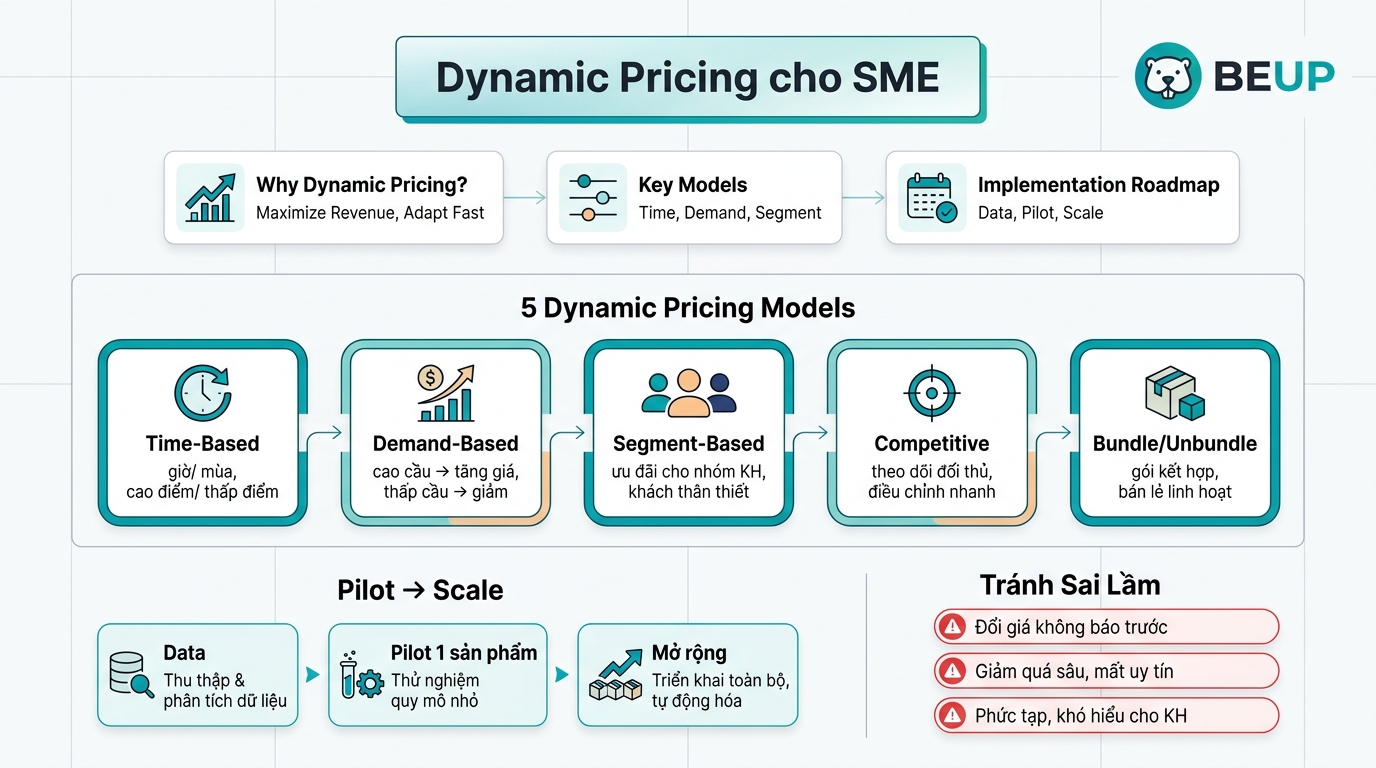
Short answer: Dynamic pricing for small businesses is a strategy that adjusts prices based on time, demand, customer segments, and competitors — without needing AI or million-dollar software. Small businesses can start with 5 basic models: time-based, demand-based, segment-based, competitive, and bundle pricing. Piloting one product for 30 days is the safest way to see results.
Most Vietnamese SME owners are pricing using one of two methods: adding a fixed margin to costs or looking at competitors and subtracting a few hundred thousand — both methods are silently leaving money on the table, missing out on revenue during peak demand and self-eliminating in the price reduction race. Dynamic pricing is not just a tool for Amazon or Grab; it's a mindset that businesses with 5-50 people can apply, often requiring just a Google Sheets table to start.
Article contents
Dynamic pricing is a strategy that adjusts product or service prices in real-time based on supply and demand, time, customer segments, competitor prices, and inventory — the same product can have different prices depending on the situation.
The common understanding is that dynamic pricing is synonymous with machine learning algorithms from large platforms. This is a misleading perspective. At its core, flexible pricing is simply acknowledging a simple reality: customers' willingness to pay changes depending on the context — peak hours, seasons, segments, and levels of urgency. Any business owner who has ever charged extra on weekends, reduced prices during off-peak hours, or divided products into basic and premium packages has already practiced dynamic pricing without realizing it.
The difference between businesses that do it systematically and the rest lies in having a clear logic, data-driven decisions, and a transparent communication process with customers. Without these three elements, any price change seems arbitrary — and that's why many small businesses are afraid to touch their pricing tables.
"Fixed pricing is a 20th-century mindset. Flexible pricing is the language of the modern market."
Fixed pricing assumes that all customers have the same willingness to pay, buy at the same time, and have the same level of urgency. This assumption is incorrect in almost every market. Customers who book wedding photography during peak season are different from those who book on a Tuesday at the beginning of the month. Print orders near Tet are completely different from those placed two months in advance. When you charge the same price for both groups, you're both missing out on premium revenue from the first group and closing the door to the second group, which only needs a more affordable price to agree.
The second, more severe consequence: without flexible pricing tools, SMEs often default to competing by reducing prices across the board. This is a one-way street that lowers the perceived value of the brand, and once taken, it's hard to reverse. Dynamic pricing offers five specific levers: maximizing revenue when demand is high, clearing inventory or filling schedules when demand is low, maintaining margins instead of engaging in price wars, segmenting customers more effectively, and competing more intelligently beyond raw price.
Principle: prices change according to the hour, day, or season. A coffee shop increases prices by 10–15% during the 7–9 am rush; a photography studio reduces prices by 20% for Monday to Wednesday bookings to fill empty slots; a fashion store increases the price of coats in November and December and decreases it in March and April. A safe starting point is to analyze revenue by week and month over the past six months, identify peak and off-peak periods, and create two price tables standard and peak with a 10–20% difference.
When many people want it, the price increases; when few people ask, the price is softer with incentives. A design agency can increase onboarding prices by 15% in the last month of the year when closing many deals; a printing factory applies a rush order surcharge of 20–30% when orders increase threefold during the Tet holiday; an accounting service charges extra for express packages during tax season. A reasonable trigger threshold is when inquiries exceed 30% of the average — and a mandatory condition is transparent notification: “promotional price applies until [date], after which the standard price applies”.
The same offering has different prices for different customer groups. An online course has student, freelancer, and business prices with a 30–50% difference; SaaS software has Starter, Pro, and Enterprise plans; consulting services have different prices for early-stage startups versus established SMEs. The key is to create three versions from the same core offering, with clear and distinct names and actual differences in features or benefits — not just empty “Basic/Pro/Premium” labels.
Monitor competitors' prices and adjust intentionally — without blindly copying. A Shopee store uses automated tools to adjust prices -5% when competitors have flash sales; a content agency maintains its original price when competitors increase theirs and instead offers additional services to increase perceived value; an import-export business monitors exchange rates and raw material prices to update FOB/CIF quotes. Create a list of 5–7 direct competitors, check prices weekly, and determine your positioning: premium (+10–20%), equal, or value (-5–10% but with clear explanations).
Combine products to increase perceived value or separate them to lower the barrier to entry. A spa sells a package of 5 sessions at the price of 4 to increase AOV and commitment; an IT company separates maintenance from development to sell subscription-based services; a publisher sells individual books alongside a bundle of 3 books at an attractive price. Look at the top 3 best-selling products, try bundling the two most popular ones into a combo with a 10–15% discount compared to individual purchases, and track the conversion rate over 30 days.
Summary: SMEs should start with a single model that suits their industry — schedule-based services use time-based pricing; agencies and consulting firms use segment-based pricing; e-commerce uses competitive and bundle pricing. Pilot for 30 days before expanding, and only combine multiple models after confirming the first model works through data.
The transition should not occur within a week. The roadmap below divides 8 weeks into five manageable phases to mitigate risk — slow enough not to alarm existing customers, yet fast enough to see results before momentum fades.
| Period | What to do | Time | Expected Outcome |
|---|---|---|---|
| Phase 1 — Data | Analyze revenue by time, segment, and product | Weeks 1-2 | Identify peak and off-peak periods |
| Phase 2 — Segment | Identify 2–3 customer segments and their willingness-to-pay | Weeks 2-3 | Establish preliminary tier pricing |
| Phase 3 — Pilot | Apply one model to a single product or service | Weeks 3-6 | Gather real-world feedback data |
| Phase 4 — Review | Compare pre- and post-revenue, margin, and conversion rates | Weeks 6-8 | Verdict: scale or adjust |
| Phase 5 — Scale | Scaling to other products/services | From March | Complete pricing system |
A 5-member content agency in HCMC records revenue of 80–120 million/month, with thin margins due to frequent price pressure. The previous pricing model was fixed-price packages — 5 articles/month for X million, 10 articles for Y million — applied uniformly to large and small clients. During the peak season, they were overloaded but couldn't raise prices because they had already reported them.
The solution implemented over 3 months combined four levers. Segment pricing divided packages into three tiers — Starter for freelancers and startups, Growth for SMEs, Scale for businesses — with a 35–40% difference. Rush pricing added a 25% surcharge for deadlines under 5 working days. Seasonal pricing increased the base price by 15% during November–December and March–April (reporting season). Loyalty bundle offered a 10% discount for 6-month contracts, but anchored the price at the Growth tier to avoid cheapening.
After 3 months, revenue increased by 31%, margin rose from 28% to 41%, and the number of clients decreased slightly but workload stabilized — the group of 'cheap, demanding' clients dropped out, and rush pricing controlled the number of urgent orders. The lesson learned: dynamic pricing doesn't require software, but clear logic and a quarter to absorb the new pricing system.
The most dangerous pitfall is changing prices without notification — old clients feel cheated, and lost trust is hard to regain. The second is reducing prices too deeply during off-peak periods, permanently lowering the perceived value; reducing 30% a few times makes clients assume it's the real price. The third is lacking clear logic — when clients ask 'why is it different today than yesterday' and you can't answer, the entire strategy collapses.
The fourth pitfall is applying dynamic pricing wholesale instead of piloting it step-by-step; piloting one product for 30 days helps you adjust before risks spread to the entire catalog. The fifth pitfall is mistaking dynamic pricing for a discount strategy — these are two different things. Dynamic pricing optimizes prices according to context to increase total revenue; discounts are short-term tools to clear inventory or test new segments. Confusing these concepts is the most common reason SMEs lose margins after applying dynamic pricing.
The free or low-cost tool layer is sufficient for SMEs to start. Google Sheets combined with Apps Script automates price tables based on conditions you define — suitable for services and B2B. Shopee Seller Center and Lazada have built-in flash sale schedulers and pricing rules for e-commerce sellers. Notion is used to manage pricing tiers, track price changes, and log decisions — essential to avoid organizational memory loss after 6 months.
The mid-tier tool layer starts from around $59/month. Prisync and Wiser automatically track competitor prices and send alerts when changes occur. The WooCommerce Dynamic Pricing plugin applies to WordPress stores. Airtable and Google Looker Studio create revenue analysis dashboards by segment — necessary when you have three tiers or more and want to measure the effectiveness of each group. Rule: only move to the mid-tier when the free tier has been running stably for 3 months.
✍ Key takeaways
TEMPLATE COMPANION
Apply dynamic pricing by industry — choose a suitable template set
Each industry has its own way of implementing dynamic pricing. The six Excel template sets below are designed for specific fields mentioned in the article — simply replace the numbers with yours and run.
Language Center
ClassPilot — managing education center operations
Segment pricing by class level, peak season during enrollment
Interior Construction
Interior Fit-out — estimation & cash flow
Bundle pricing by project phase, rush premium for tight deadlines
Online Sales
E-com Navigator — profit & cash flow
Competitive pricing for Shopee/Lazada, flash sale margin tracker
F&B / Restaurant
F&B Recipe & COGS — controlling cost of goods
Time-based menu pricing, maintaining margin when raw materials fluctuate
Room rentals
Complete rental property management
Seasonal pricing based on student seasons, loyalty discounts for long-term contracts
Transportation/Logistics
Fleet Trip — managing vehicle fleets & shipments
Demand-based fees, rush surcharge by route and time
It is completely legal. The 2023 Price Law only regulates price-stabilized goods like gasoline, electricity, and public healthcare; ordinary commercial products and services are allowed to have flexible pricing. The key condition is to clearly post prices at the time of transaction and not apply different prices to the same customer under the same conditions.
Yes, and it's recommended to start as soon as possible. Small businesses with fewer than 10 employees have the advantage of making quick decisions, easily testing, and having personal relationships with customers, making it easier to explain price changes. Start with segment-based or time-based pricing, as these are the simplest models, and you can use Google Sheets to track them in the first 30 days.
Notify them 30-45 days in advance via direct email, explain the reason (increased costs, service upgrades, tier structure changes), and offer existing customers the opportunity to lock in the old price for an additional 3-6 months if they sign a contract before the deadline. The customer retention rate when following this process is usually over 85% according to B2B service industry data.
Surge pricing is a specific type of dynamic pricing applied to real-time markets where supply and demand change by the minute. Dynamic pricing for small and medium-sized enterprises (SMEs) is broader: it includes segment pricing, seasonal pricing, bundle pricing — most of which do not require real-time adjustments and can be updated weekly or monthly. SMEs should not copy the surge pricing model as it may create a sense of unfairness among B2B customers.
A 30-day pilot is enough to see initial signals about conversion rates and customer feedback. Significant financial results (revenue, margin) usually appear after 2-3 months when the system is stable and customers have adapted to the new tier structure. A case study of a 5-person agency in this article achieved a 41% margin after exactly 3 months — a pace suitable for most service-based SMEs.
References: Vietnam Price Law 2023 · Harvard Business Review — “How to Price Your Services” (2022) · Hermann Simon — Confessions of the Pricing Man (2015)
—
Get insights on management, operations & digital assets delivered to your inbox.

Copyright © 2026 BEUP Learning Solutions
MST: 3301755602
Book a free consultation to explore how BEUP can transform your workflow.
Book a Consultation →Digital Asset Ecosystem & Operating System for individuals & teams.