No products in the cart.

10 min read
A 7-person furniture company in Binh Duong lost its sales manager after three years. The new hire, experienced and qualified — but after two months still didn't know which supplier to order raw materials from.
He couldn't grasp the pricing history with each partner. He also didn't understand why client A always requested invoices on the 25th instead of the end of the month.
None of that information was in any file. It was all in the head of the person who left. This is the problem that business knowledge management needs to solve.
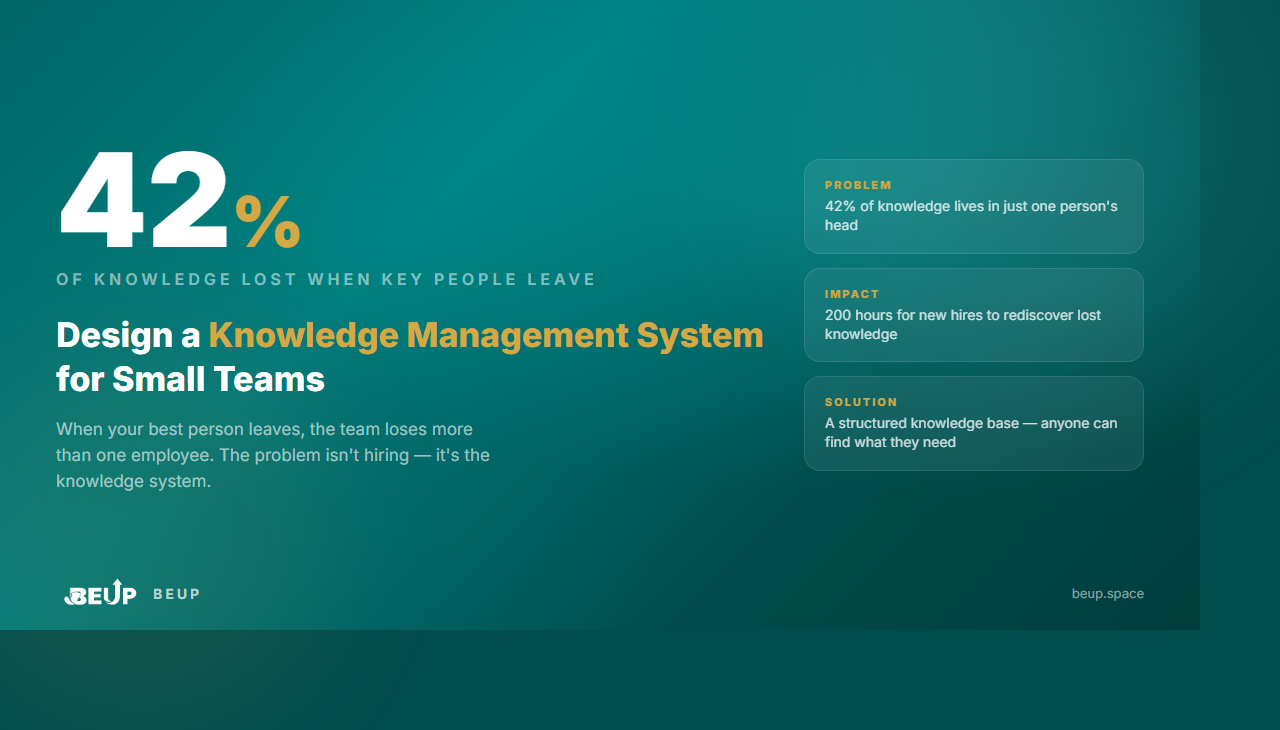
This is not uncommon. Research from HR Daily Advisor indicates that, on average, 42% of the knowledge required to perform a role exists only in the head of the person holding that position.
When they leave, colleagues cannot perform nearly half of the work. Furthermore, the replacement takes nearly 200 hours — equivalent to 5 weeks of work — just to rediscover what the previous person already knew.
The problem isn't hiring the wrong people. The problem is never having a system. designed for knowledge management to retain knowledge as personnel changes.
Table of Contents
In the software industry, there's a concept called bus factor. It represents the minimum number of individuals whose departure would lead to the complete paralysis of a system or process.
Should a single individual's departure render the entire team unable to proceed, the bus factor is 1 — the most critical level. Specifically, research indicates that 65% of systems have a bus factor of 2 or lessOperations can be disrupted if just two people leave.
For small businesses, the problem is even more severe. When a team consists of only 5–7 people, each individual often juggles multiple roles — from sales and customer care to operational management. Knowledge isn't evenly distributed; it's concentrated in one or two key individuals.
When those individuals leave — whether due to resignation, extended leave, or moving to another position — the team doesn't just lose an employee. They lose customer relationships, specific ways of handling situations, and operational “tricks” that no one ever documented.
However, 47% of businesses confirm that losing internal knowledge is the biggest challenge when an employee leaves. It's not about hiring a replacement, nor about handing over tasks — it's about the knowledge disappearing with the person.
Ikujiro Nonaka and Hirotaka Takeuchi — two Japanese researchers, authors of the book The Knowledge-Creating Company — distinguish between two types of knowledge within organizations.
Explicit Knowledge (explicit knowledge) is what has been recorded: processes, price lists, contract templates, software user manuals.
Tacit Knowledge (tacit knowledge) is what lies within the experience, intuition, and habits of each individual. For example, how to handle customer complaints, knowing which supplier is reliable when urgently needed, or understanding why a process is designed a certain way.
Explicit Knowledge — can be immediately read, copied, and transferred: documents, spreadsheets, recorded procedures.
Tacit Knowledge — can only be acquired through experience: relationships, situational judgment, and decision-making context. This is the 42% that organizations lose when key personnel depart.
Nonaka and Takeuchi call the process of transforming tacit knowledge into explicit knowledge externalization. This is the core of every effective knowledge management system.
In reality, most small businesses in Vietnam operate entirely within the realm of tacit knowledge. Everything is passed down orally, learning happens through observation, and situations are handled based on personal experience.
That model works — until the experienced person leaves. At that point, the organization discovers that what they thought “everyone knew” was actually only known by one person.
Many small teams think they have “knowledge management” because they have Google Drive with documents or a Zalo group for file sharing. Some have a few note pages on Notion. But personal notes and knowledge management are fundamentally different.
Note-taking is for oneself — arbitrary structure, found by memory, understood by no one but the writer. Knowledge management is for the organization — categorized, structured. Anyone in the team can find the necessary information without asking anyone.
Tiago Forte — author of Building a Second Brain — proposes the structure PARA. This method is currently being applied at Toyota, Genentech, and by over 500,000 people worldwide. PARA consists of Projects (ongoing projects), Areas (areas of responsibility), Resources (reference materials), and Archive (archived items).
This structure is immediately applicable to both individuals and organizations. More importantly, it answers the question that most note-taking systems fail to address: where do I find this information?
“It is about optimizing a system outside of yourself — so your mind is free for creativity, not storage.”
— Tiago Forte, Building a Second Brain
A good knowledge base operates like a library: it has clear classification (taxonomy) and navigation. Anyone can find the information they need without asking a librarian.
Therefore, research from MatrixFlows on over 500 knowledge base systems reveals three decisive factors. First, classification with no more than 5–7 main categories. Second, each page has a single and clear topic. Third, content is cross-linked for users to explore related information.
Before thinking about tools or software, the first step in designing knowledge management is a simple test. List the ten most important processes or pieces of knowledge within the team.
For example, from handling customer complaints to the raw material ordering process, from salary calculation to product pricing logic. For each item, answer two questions: how many people in the team know how to do this? and if the main person leaves tomorrow, who can immediately take over?
Tasks solely understood by one individual — those with a bus factor of 1 — should be prioritized for externalization. There's no need to document everything concurrently. Documenting the three most critical processes within two weeks has demonstrably reduced organizational risk.
Each documentation page only needs to answer four things: the purpose of the process, the steps to follow in order, common pitfalls new users often miss, and who to contact when encountering issues.
Therefore, this approach does not require special software — a Notion page, a Google Doc, or even an Excel file will work. The important thing is that knowledge must leave one person's head and reach a place accessible to the entire team.
PRACTICAL TOOLS
Practical Knowledge Base — A Comprehensive Guide with Notion
Free 14-chapter course — a step-by-step guide to building a knowledge base on Notion, applying 4 practical methods (LATCH, DIKW, PARA, Zettelkasten). From knowledge audit to classification structure, from individual to organization.
The most common mistake when starting to build a knowledge base is trying to record everything at once. The result is often a pile of documents that no one can find, no one updates, and after a few months, they are forgotten.
This is exactly the “dead processes” Michael Gerber describes in The E-Myth Revisited. An effective knowledge base for a small team needs the right structure more than a lot of content.
The first design principle: categorize by functional area (sales, operations, finance, HR), not by person. When knowledge is tied to an individual's name, it disappears with that individual. When knowledge is tied to a functional area, it belongs to the organization.
The second principle: each page contains only one process or one piece of knowledge. That page needs an assigned owner and the last updated date — so anyone knows if the information is still accurate.
The third principle: review quarterly — delete what's no longer correct, update what has changed, and add what's missing.
In summary, these three principles — categorizing by functional area, one topic per page, and regular reviews — are sufficient to operate a knowledge base for a team of under 10 people. No expensive software or external consulting is needed.
You only need an afternoon to set it up, and the discipline to update it whenever there's a change.
OPERATING SYSTEM
Small Team OS Lite — Operating Small Teams for Free
If your team needs a broader system — for project management, task assignment, KPIs, and a knowledge base — Small Team OS Lite is an 11-database framework on Notion for teams of 2–10 people.
📌 Key Takeaways
For small teams serious about building a foundation.
Knowledge management is a system for storing, organizing, and sharing knowledge within an organization. Its purpose is to ensure information doesn't depend on any single individual.
Small businesses (SMEs) particularly benefit, as individuals often wear multiple hats, resulting in a low bus factor. Consequently, the departure of one person carries a disproportionately larger impact compared to larger enterprises.
Initiate with a bus factor audit: enumerate the 10 most critical processes, pinpoint tasks known by only one individual. Subsequently, prioritize documenting the three highest-risk items.
Use Notion, Google Docs, or any tool your team is already familiar with. The important thing is the structure and the habit of updating, not the software.
Personal notes serve the writer — with arbitrary structure, retrieved by memory. On the other hand, a knowledge management system serves the organization — with classification (taxonomy) and consistent structure. Any member can find necessary information without asking the original author.
Notion is the most popular choice for small teams because it's free, flexible, and offers good database structuring. Google Docs + Sheets also works if the team is already familiar with them.
Confluence is suitable if the team uses Atlassian products. However, the deciding factor is not the tool, but the classification structure and the discipline of updating.
References: Nonaka, I. & Takeuchi, H. — The Knowledge-Creating Company (1995, Oxford University Press) · Forte, T. — Building a Second Brain (2022, Atria Books) · Gerber, M. E. — The E-Myth Revisited (1995, HarperCollins) · HR Daily Advisor — “42% of institutional knowledge is unique to the individual” (2018)
A small business operating system doesn't start with expensive software...
Mar 17, 2026Context switching costs you 23 minutes every time you switch tasks. With AI, the problem...
Mar 26, 2026Hệ thống hóa vs tự động hóa: thứ tự đúng cho doanh nghiệp nhỏ. Đừng...
Apr 07, 2026Get insights on management, operations & digital assets delivered to your inbox.

Copyright © 2026 BEUP Learning Solutions
MST: 3301755602
Book a free consultation to explore how BEUP can transform your workflow.
Book a ConsultationDigital Asset Ecosystem & Operating System for individuals & teams.