No products in the cart.

7 min read
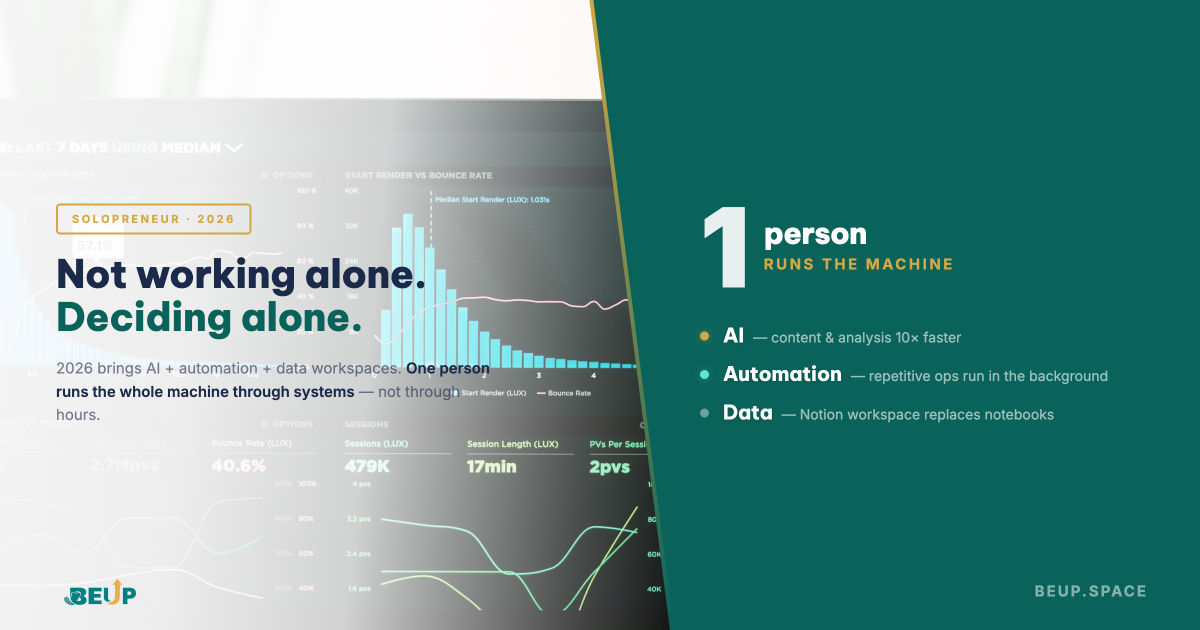
Short answer: The solopreneur of 2026 isn't just someone who works alone, but also makes decisions alone, leveraging three layers of cumulative advantage: AI for speed, automation for repetitive ops, and data-driven workspaces — all while avoiding the trap of getting caught up in building and forgetting to sell.
Article contents
Re-reading an old interview about solo workers in the industrial age, I realized something that's now clear to me: a solopreneur is not someone who works alone, but someone who making decisions alone. That's the most important difference, and also the one that few people acknowledge when discussing this model.
Freelancer sales time of your own; when the clock runs out, the money runs out. A solopreneur builds system to have a system sell for you; even when you're sleeping, there's still a steady stream of income.
The gap between these two states seems technical, but it's actually very human. It's the gap between believing you must do everything yourself to be valuable, and believing that what you've been through, tried, failed, and fixed can be packaged into something useful for others without your physical presence.
The cost? Every decision is yours to make alone, with no one to share the responsibility or provide input on products, pricing, marketing, or support.
Right or wrong, it's simple: you win or you lose.
But in return, you get speed You decide in the morning, and deploy in the afternoon. In 2026, when AI gives you the ability to build ten times faster, that speed is a huge advantage.
For solopreneurs, this is a significant problem, as there's no one to remind them or ask about their pipeline or MRR.
You're alone. And your inner urge to "build" keeps whispering:
"Just one more feature…"
"Let me redesign the dashboard to make it look better…"
"Maybe I should create a new product?"
I used to fall into this vicious cycle, creating over 20 digital products — Notion templates, Excel tools, and automated workflows — only to watch them collect dust.
It's not that the product is bad. It's just that you haven't sold it yet.
The day you actually start selling, posting real content, talking about the real pain of your customers, meeting them one-on-one, listening, is when your revenue starts to move.
A lesson, bitter but necessary to remember: A solopreneur who can't sell is just a hobbyist with a beautiful website.
Five years ago, to run everything by yourself — marketing, sales, operations, support, finance — you had to be a superhero. Or you had to accept lower quality in some areas. Today is different. You have three things that add up.
I use AI to write product descriptions, analyze market templates, create content schedules, and even QA products, reducing tasks that used to take 2 days to just 2 hours.
But note: AI helps you faster, doesn't help you more accurately. You still need to be the decision-maker. AI doesn't know what your customers need; you need to sell to find out.
This is where the game changes. Instead of copy-pasting data between 5 tools, I use n8n (self-hosted) to automate:
Each workflow takes 2-4 hours to build, saving dozens of hours per month. I've packaged these workflows into a product, which includes BEUP Flow — a plug-and-play workflow suite for SMEs and solopreneurs. If you're new to automation, this article n8n for Business explaining why self-hosting is 10× cheaper than Zapier at scale.
My philosophy from the start: data first, text later. Instead of using Google Doc to write to-do lists, I built a Notion workspace with:
That workspace has been packaged into Solopreneur Business OS — 6 database connections, 12 KPI charts, and pre-built AI prompts for freelancers, creators, and consultants who want to run a business alone without feeling overwhelmed.
Many people are afraid to run a business alone, thinking they'll be lonely and lack support for brainstorming and decision-making.
In reality, I have:
Solopreneur doesn't mean solo. Perhaps a more accurate term would be: you are the only one ultimately responsible But the ecosystem around you — people, AI, automation, community — that's your true team.
Solitude here means the lack of responsibility is sharedA different kind of solitude, not tragic or melancholic, but a quiet maturity that solo entrepreneurs must go through
It's not complicated. Just four steps:
Steps 1 and 3 are the most important. The rest you can learn gradually as you work.
I do these things because I use them every day. Then package it for others to use. That's the essence of being a solopreneur: turning operating experience into products.
In a few years, the world may be flooded with AI-generated templates, workflows, and tools: faster, more beautiful, and technically perfect. But what may become the most luxurious, perhaps, is not productivity, but the feeling of using something that still bears the mark of a person who truly lived with the problem the product is trying to solve.
Freelancers sell time: no hours, no pay. Solopreneurs build systems/products that sell for them — digital products, templates, workflows, memberships — so they can earn money even while sleeping. The key difference lies not in skills, but in the revenue model.
No. By 2026, AI can write code better than 90% of basic questions, and no-code/low-code tools like n8n, Notion, Airtable, and Webflow are enough to create sellable products. What you need is systems thinking: knowing how to break down work into automatable steps, knowing how to organize data before organizing the interface.
Under 1 million VND/month is enough to start: Notion Free or Plus (~$10), self-hosted n8n on VPS Hostinger (~80k/month), and Gumroad/Lemon Squeezy only charge when you make a sale. No office or employees needed. Most investment should go into learning time and go sell, not just using tools.
Simple rule: talk to 10 people in your target audience before doing anything. Describe the problem (not the product), and see how they react. If 3 out of 10 people say “I'd pay for that” without you having to convince them, that's a good sign. But if they just say “that's cool”, they're unlikely to buy.
It won't replace, but will turn common products (tier 1) into cheap commodities. AI-generated templates, workflows, and content will be abundant and affordable. What will become more valuable is vertical depth (in-depth understanding of a specific industry or problem) and service layer (Setup, support, and mentoring). Solopreneurs who win in the long run use AI to scale, but keep judgment and customer relationships in-house.
The two products below are what I described in the “operating system” section — not affiliate marketing, not sponsored by anyone, but something I built myself and packaged for you so you don't have to start from scratch:
DATA WORKSPACE AT THE CORE
Notion workspace with 6 connected databases: Projects, Tasks, Customers, Content, Finance, and Goals. 12 KPI charts, 30+ pre-built views, and AI prompts. Runs on Notion Free.
AUTOMATION
The n8n workflow package for SMEs and solopreneurs: CRM, content duplication, daily briefs, and AI support. Plug-and-play, bilingual VI/EN, and self-hosted on a VPS for <100k/month.
Are you running solo or just starting out? Share your story — I'd rather hear the truth than something sugarcoated.
Get insights on management, operations & digital assets delivered to your inbox.

Copyright © 2026 BEUP Learning Solutions
MST: 3301755602
Book a free consultation to explore how BEUP can transform your workflow.
Book a Consultation →Digital Asset Ecosystem & Operating System for individuals & teams.