No products in the cart.

6 min read
A small sewing workshop can operate for years without management software. But no workshop can last long without knowing how much fabric it has in stock.
The problem isn't stolen fabric. The problem is that 50 meters shipped yesterday went unrecorded. It's the roll of fabric imported in March that sat in a corner until September, only to be discovered yellowed. It's the urgent order for 500 shirts, only to find out after a 2-hour inventory check that there isn't enough fabric.
This isn't a technology problem. This is a problem of information.
In this article
Most small sewing workshops, when discussing inventory issues, use the phrase “losing fabric.” But in reality, fabric doesn't just disappear. It's dispatched — but no one records it. Or it's recorded incorrectly. Or recorded so late that no one remembers how much was dispatched.
A few familiar scenarios:
All three scenarios share a common root cause: lack of accurate information at the right time. It's not a human error. It's a system error — or more precisely, the error of not having a system.
When discussing losses from poor inventory management, people often think of lost fabric. But in reality, the biggest costs lie in places no one notices:
“The cost of not knowing what you have in stock is always greater than the cost of any management system.”
If you've ever tried using a generic inventory management file (the kind used for stores, pharmacies, components) to manage fabric, you'll find it's missing many things. Because fabric is not a typical commodity:
| Features | Typical Inventory | Fabric warehouse |
|---|---|---|
| Units of Measure | Pieces, boxes, items | Meters, kilograms, rolls (varies by type) |
| Lot Differentiation | Not necessary | Required (color variation between dye lots) |
| Deterioration Over Time | Ít | Yellowing, mold, brittleness, shrinkage |
| Capacity | By quantity | By shelf length + weight |
A generic inventory management system won't have a “dye lot” column, won't have inventory age alerts, and won't calculate shelf capacity by meters. And these are precisely the things that cause discrepancies in your fabric inventory.
No need for complexity. A system fabric inventory management can be achieved by answering 4 key questions at any time:
Current stock of each fabric code, updated instantly after every transaction (in/out). No need to manually count.
Specific shelf location of each fabric roll. Even new staff can find it immediately.
Stock age of each roll — when it was received, how long it has been stored. Prioritize shipping older stock first.
Automatic alerts when stock falls below minimum level — reorder proactively, avoid reactive purchasing.
If your file can answer the 4 questions above without needing to open the warehouse and count, you already have a functional system. If not — you are relying on memory, and memory is not a system.
Short answer: depends on the scale of your operations.
Dedicated WMS (Warehouse Management System) software is designed for large factories: thousands of SKUs, barcode scanners, ERP integration. Fees range from 2–15 million VND/month. For a garment workshop with fewer than 30 employees and under 200 fabric codes, that's overkill.
Excel for Fabric Inventory Management linked formulas can solve 90% of a small workshop's needs: real-time inventory tracking, stock alerts, fabric age tracking, and summary reports. Cost: 0đ (if built yourself) or a one-time fee (if using a template). Share via Zalo. Anyone can open it.
You don't need to wait until you're 'free' to reorganize your inventory. You also don't need to buy anything extra. All it takes is one afternoon and a new convention:
“The best system isn't the most expensive one. It's the system you actually use every day.”
Yes. Inventory discrepancies don't depend on the number of SKUs, but on whether inbound and outbound movements are recorded. Forgetting to record just one roll can throw off your entire inventory.
Workers don't input data. The warehouse manager does. Workers only need to report the SKU code and the number of meters taken — either by writing it down or sending a Zalo message.
Add columns for 'import batch' and 'supplier.' The same fabric SKU but from different dye lots needs to be tracked separately to avoid color discrepancies during sewing.
Yes, absolutely. It's highly compatible. Additional advantages include: multiple people can view simultaneously, and data is automatically saved to the cloud.
If you're looking to improve your sewing workshop's operations, the following articles will be helpful:
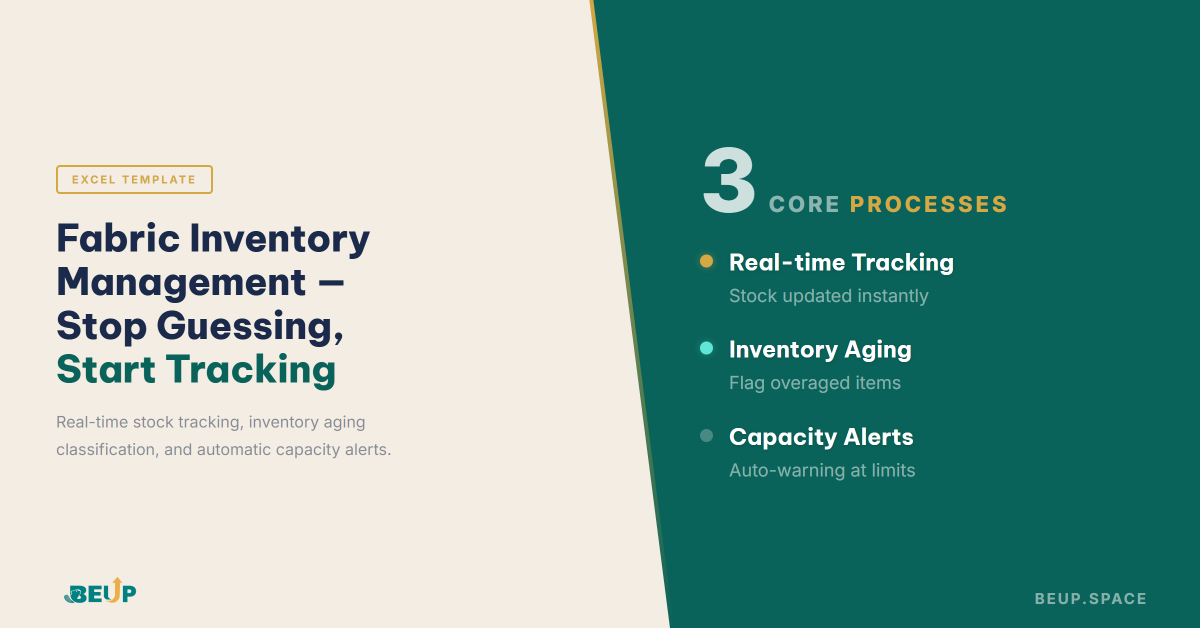
BEUP has developed a template suite Fabric Inventory Management — featuring real-time stock movements, tracking of inventory age and dye lots, capacity alerts, and consolidated reports. Specifically designed for garment factories and small manufacturing businesses.
Get insights on management, operations & digital assets delivered to your inbox.

Copyright © 2026 BEUP Learning Solutions
MST: 3301755602
Book a free consultation to explore how BEUP can transform your workflow.
Book a Consultation →Digital Asset Ecosystem & Operating System for individuals & teams.