No products in the cart.
10 min read
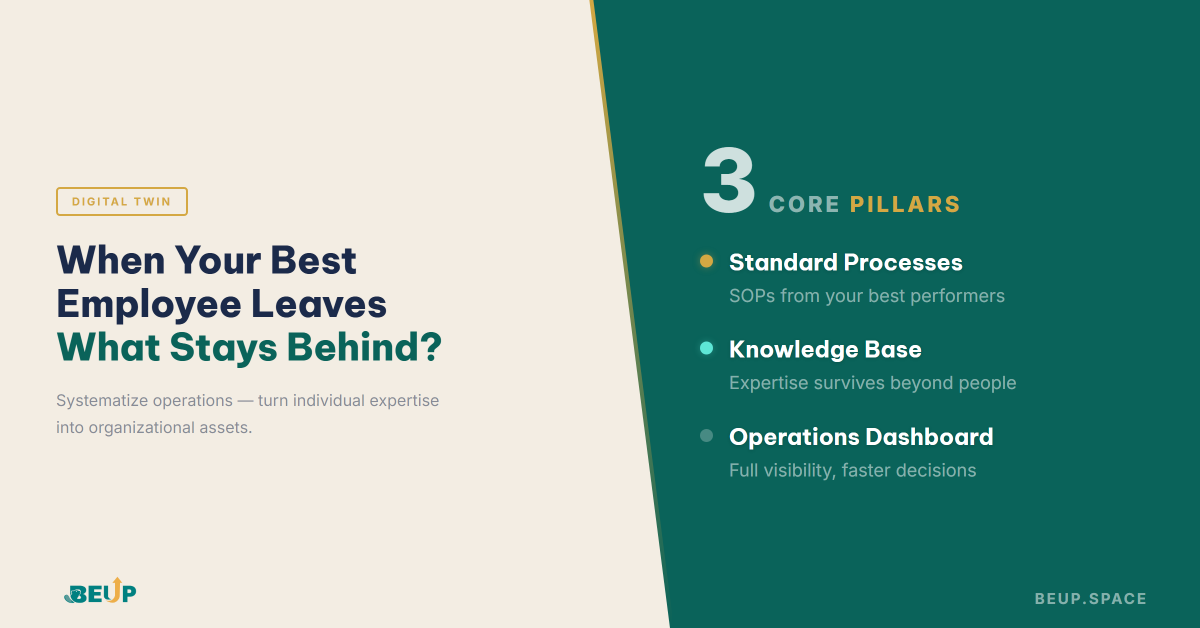
Short answer: A business digital twin is the process of systematizing an organization's best operating practices — from how skilled employees handle tasks, to decision-making processes, to the entire operational flow — into a “digital blueprint“ that anyone on the team can use. With AI support, this blueprint is not just a static document but becomes a system that can suggest, respond, and guide according to specific contexts.
An interior design company with 30 employees. The Sales Manager — the best person on the team — resigned after 4 years. Within 2 months, the closing rate dropped by 40%.
Not because the team was incompetent. All the expertise in handling difficult clients, how to discern real needs from superficial questions, how to determine the optimal time to send a quote — all resided in one person's head. And that person just walked out the door with all of it. This is precisely why a business digital twin is becoming a critical topic for every SME.
This situation is not uncommon. In most SMEs, operational knowledge exists as “tacit experience”. No one records it, no one systematically communicates it. This knowledge only becomes apparent when the person possessing it leaves.
In other words, digital twin — a concept from industrial manufacturing — is being re-applied in the context of small business management. This could be one of the most important transformations SMEs need to understand.
Article content
Business Digital Twin is a digital replica of how an organization operates — including processes, decision-making methods, specialized knowledge, and workflow — recorded in a structured way so that anyone on the team can access and use it.
The concept of digital twin originated in manufacturing. NASA created digital replicas of spacecraft to simulate failures before they occurred. Siemens uses digital twins for factories — each machine has a virtual version that accurately reflects its real-world status.
However, the core principle is not scale-dependent. If you can accurately describe how a system operates, you can optimize it without trial-and-error on the real system.
Applied to small businesses, a digital twin doesn't require million-dollar software. It starts with a simple question.
If your entire team quit tomorrow, could a new group of people operate the business at 70-80% capacity using only the documentation and systems you left behind?
If the answer is no — and for most SMEs, the answer is no — then you don't have a digital twin.
Specifically, think about the franchise model. McDonald’s can open 40,000 stores worldwide not because every single store has Ray Kroc overseeing it.
Therefore, the entire operational process has been documented into a detailed playbook. A new employee can brew coffee to standard on their first day. That is a digital twin at the business level. You don't need a literal franchise, but you do need an equivalent level of systematization.
Every organization has individuals whose absence slows things down. For example, it could be the Head of Customer Service who knows how to handle complex complaints without escalation. Or the Chief Accountant who remembers the specific tax implications of each contract type. Or the warehouse staff who knows exactly which items are prone to errors and how to quickly check them.
This knowledge in management is called tacit knowledge — tacit knowledge, accumulated through experience. It is almost impossible to convey through a single training session.
An employee digital twin is a way to “externalize” that tacit knowledge. Not by asking them to write a 50-page SOP — because no one will do it, and if they do, no one will read it. Instead, a more effective process has 3 layers:
Layer 1 — Decision log: Record real-life situations and how they were handled. No theory needed, just: “Customer asks X → answer Y because Z”. Accumulate 50-100 situations, and you'll have most of the practical, on-the-ground experience of a skilled employee.
Layer 2 — Process map: The steps for handling repetitive tasks — from receiving a request to completion. No need for click-by-click detail, just enough for a new person to understand the workflow and know when to ask whom.
Layer 3 — AI layer: Use AI (internal chatbot, assistant) to understand the decision log and process map, then answer new employees' questions contextually. This layer transforms static documents into a “virtual colleague” — not replacing people, but reducing Q&A time by 60-70% during the first month of onboarding.
Ikujiro Nonaka — a professor of management at Hitotsubashi University — describes this process as “knowledge conversion” within the SECI model. This model progresses from Socialization (oral transmission, mentorship) to Externalization (documenting into structured artifacts).
In reality, most small businesses get stuck at the Socialization stage. Knowledge is only transferred when two people are physically together. A digital twin is a way to overcome this limitation.
This company's customer service department had 2 senior staff handling 80% of complex complaints. After building a digital twin for this role, the team documented 120 common complaint scenarios along with their handling procedures and internal policies. All of this was then integrated into an internal AI assistant.
As a result, new employees could independently handle 65% of cases that previously had to be escalated to seniors. Onboarding time decreased from 6 weeks to 2 weeks. More importantly: when a senior took 2 weeks of leave, the team didn't get bottlenecked.
If an employee digital twin solves the problem of “knowledge residing in one person's head”, then an enterprise digital twin addresses a larger issue. That is: the entire operating system resides in the founder's memory.
This is what Michael Gerber — author of The E-Myth Revisited — calls the difference between working trong small business and work on small business. Most small business owners spend 90% of their time on daily tasks. Almost 0% of their time is dedicated to building systems for the business to operate autonomously.
“The system runs the business. The people run the system.”
— Michael Gerber, The E-Myth Revisited
A digital twin of a business is a comprehensive “operational blueprint” that includes: (1) processes for each department and how they connect, (2) quality standards and KPIs for each position, (3) decision trees for common situations, (4) a centralized knowledge base for all internal knowledge.
Once you have these four elements in place, you can hand over the business to an entirely new team. At least in theory, they could operate at an acceptable level within the first week.
It might sound ideal, but this is exactly how franchise chains operate.
Moreover, with AI, the “contextual lookup and guidance” aspect becomes more feasible than ever. Instead of reading 200 pages of SOP, an employee asks the AI assistant “the customer wants to return an item after 15 days, what's the policy?” They get a precise answer based on internal policies, with a link to the specific procedure.
Key point to emphasize: a digital twin for a small business is not just about 'buying software'. It's a process — the process of documenting, structuring, and continuously updating how a small business operates. Software and AI are merely the tools on top. The true foundation is knowledge recorded correctly.
The biggest mistake when starting to build a digital twin is trying to document everything at once. The result: a 3-month project, documents no one reads, and the team reverts to old ways. A more effective approach is to start with the most obvious pain point.
Step 1 — Identify the “single point of failure” in your team. This is the person or position whose absence immediately bottlenecks work. It's often the most senior employee, the one who handles complaints, or the only person who knows how to operate a specific system.
Start here because the impact is highest. Additionally, the people involved are usually motivated to cooperate because they also want to reduce their workload.
Step 2 — Record decision logs, not SOPs. Instead of writing A-Z processes (time-consuming, quickly outdated), record the real situations and how they were handled. Simple format: “When [situation] → [action] → because [reason]”.
The goal is 50-100 entries in 2-4 weeks. This is the knowledge base that AI can read and answer questions from.
Specifically, a structured knowledge base tool — like Notion with databases categorized by topic and department — will significantly speed up this process compared to scattered Word files.
Step 3 — Add an AI layer when the knowledge base is robust enough. Once you have 100+ entries, you can connect the knowledge base with an AI assistant (ChatGPT custom, Claude project, or an internal chatbot via API) to create an interactive layer.
Therefore, new employees ask questions and AI answers based on internal knowledge. Employees handle tasks immediately instead of waiting for a senior person to be available. This is the step where the digital twin transforms from a “document” to a “living system”.
The first mistake is equating digital twin with traditional SOPs. SOPs in PDF or Word files stored on Drive are static documents. They become outdated within 3 months of being written, and no one ever reopens them.
However, a digital twin is different because it's a living system. It's continuously updated, structured for AI readability, and designed to used daily rather than to 'just have it'. If the team doesn't use the knowledge base weekly, you're building SOPs, not a digital twin.
The second mistake is trying to replace people with systems. A digital twin is not meant to eliminate employees. Its purpose is to free up skilled employees to focus on complex tasks instead of answering the same question 10 times a week.
For example, if a sales manager spends 5 hours a week answering policy questions for their team, a digital twin frees up those 5 hours. They can then focus on big deals or strategic training.
The third mistake is starting with technology instead of knowledge. Buying an AI chatbot before having a knowledge base is like installing GPS in a car without a map.
No matter how powerful the AI, it cannot provide accurate answers if internal knowledge hasn't been recorded. Therefore, always start with knowledge; technology comes later.
📌 Key Takeaways
BATTLE-TESTED TOOL
Practical Knowledge Base — Notion
A set of pre-structured Notion templates for decision logs, process maps, and internal knowledge bases — the foundation for building a digital twin for teams under 50 people. Includes guidance on how to record and categorize knowledge so AI can read it.
A business digital twin is a digital simulation of how an entire organization operates. It encompasses processes, decision-making methods, and expert knowledge — structured so that AI can interpret it and provide contextual support to employees.
Unlike traditional SOPs (static Word files that no one reopens after writing), a digital twin is a living system. It's used daily, continuously updated, and features an AI layer for instant employee lookup.
Even more so. Small businesses often heavily rely on 1-2 key individuals — when they take leave or quit, the entire team gets bottlenecked. A digital twin helps mitigate this “single point of failure” risk. Start by documenting 50-100 real-world scenarios handled by the most critical position, with a total time investment of about 2-4 weeks.
The initial phase costs almost nothing — just need Notion (free), Google Docs, or any tool the team has used. The main cost is the time spent documenting knowledge (2-4 weeks for the first position).
When adding an AI layer, API costs are approximately 500K-2 million/month depending on usage volume. Compared to the cost of losing skilled employees or extended onboarding, this is an investment with a clear ROI.
Skilled employees often worry that sharing knowledge will make them “less important”. An effective approach: position the digital twin as a tool to reduce their workload.
Instead of answering repetitive questions 10 times/week, the system answers them. They can focus on higher-value work. Additionally, acknowledging contributions by naming contributors in the knowledge base also fosters natural ownership.
No. A digital twin records the experience of handling situations. already known. However, actual work always generates new situations requiring judgment, creativity, and human interaction.
The goal is to free up skilled employees from repetitive tasks (answering policy questions, guiding processes). This allows them to focus on the parts that truly require deep expertise and experience.
References: Michael Gerber — The E-Myth Revisited (1995) · Ikujiro Nonaka & Hirotaka Takeuchi — The Knowledge-Creating Company (1995) · McKinsey Digital — Digital Twins: The Art of the Possible in Product Development and Beyond (2022)
Get insights on management, operations & digital assets delivered to your inbox.

Copyright © 2026 BEUP Learning Solutions
MST: 3301755602
Book a free consultation to explore how BEUP can transform your workflow.
Book a Consultation →Digital Asset Ecosystem & Operating System for individuals & teams.