No products in the cart.



8 min read
Open ChatGPT, paste the product name, generate, and copy into the listing. This is how 90% of Vietnamese sellers use AI — and also why no one stands out. When everyone uses the same tool in the same way, the result is thousands of identical product descriptions. AI is no longer a competitive advantage — it becomes a baseline that anyone can reach.
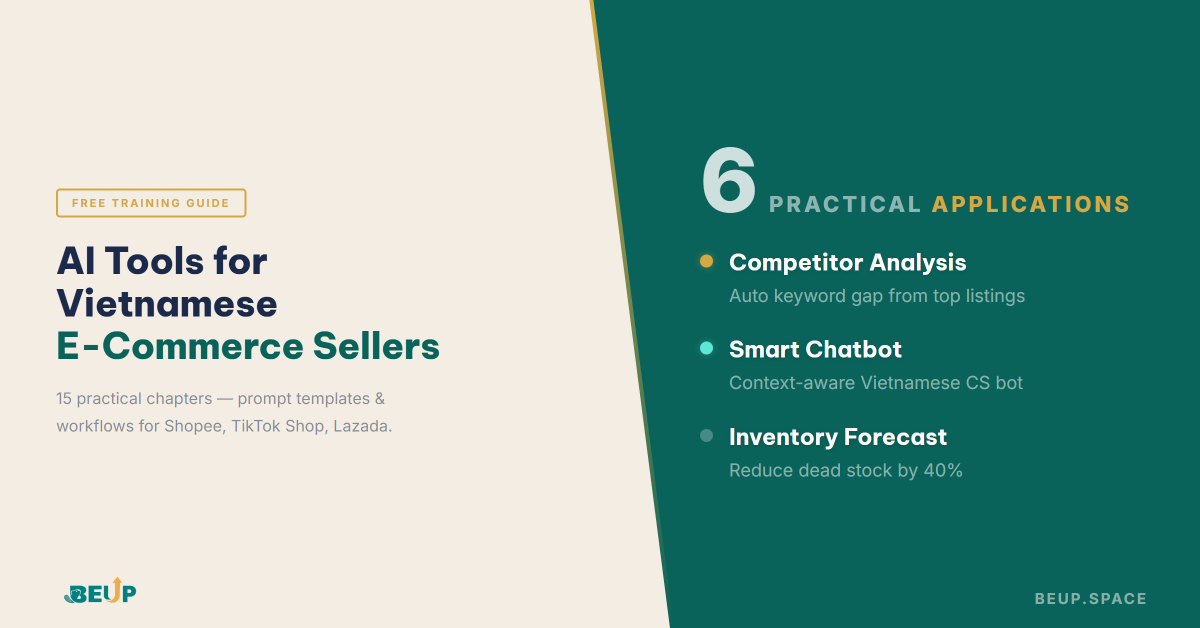
This article doesn't discuss how to write better prompts. It discusses 6 Applying AI in E-commerce that most sellers are missing — applications that turn AI from a writing tool into an analysis, decision-making, and automation system.
Short answer: Applications of AI in Vietnamese e-commerce go beyond writing product descriptions. 6 practical applications include: analyzing keyword gaps from competitor listings, optimizing prices based on market data, predicting inventory to reduce dead stock, chatbots that understand customer context, analyzing reviews to improve products, and creating visual content in bulk for A/B testing. Small sellers can start for free with ChatGPT, larger sellers invest 2-5 million VND/month for a full automation stack.
In this article
In 2024, when ChatGPT became popular in Vietnam, sellers who knew how to use AI to write product descriptions had a clear advantage — more professional listings, better SEO, faster product release. But by mid-2025, almost all sellers were doing the same. The result is that thousands of listings on Shopee and TikTok Shop read like they were written by the same person — because they were written by the same tool, with the same prompt.
| How to use AI commonly (everyone does) | How to use AI to gain an advantage (few do) |
|---|---|
| Write product descriptions | Analyze 500 competitor listings → find keyword gaps |
| Respond to customer chats | Chatbot understands order context + purchase history |
| Create product images | Create 50 visual A/B test variants in 1 hour |
| Write advertising articles | Analyze ad performance → automatically adjust copy |
| Translate listings into English | Localize listings by marketplace (Shopee MY ≠ VN) |
The left column is the baseline — things AI does well and everyone already knows. The right column is where the real competitive advantage lies. Sellers who are winning are not because they write better descriptions, but because they use AI to analyze the market, predict demand, and automate decisions — tasks that competitors are still doing manually or by instinct.
1. Automatic competitor and keyword gap analysis. Instead of guessing what customers are looking for, take the URL of the top 10-20 listings in the same category, paste it into AI for analysis: which keywords competitors are using that you don't have, what the average price is, strengths and weaknesses in writing descriptions. Output is a list of supplementary keywords with suggestions for different angles — something that manual research takes 4-5 hours, AI does in 15 minutes. Cost: 0 VND if using free ChatGPT, under 500,000 VND/month if using GPT-4.
2. Optimize prices based on market data. Tracking competitor prices daily is not technically difficult — but analyzing to make new pricing decisions is the important part. AI can evaluate price sensitivity by category: basic products like t-shirts, customers are less price-sensitive (15% reduction only increases 8% purchases), so it's better to keep prices and offer gifts instead of reducing prices. On the contrary, highly competitive products like phone accessories, a 5,000 VND difference is enough to lose customers. AI analyzes Flash Sale history to propose optimal reduction levels — attractive enough without eating into margins.
Example in Practice — Pricing Decision in Flash Sale
Basic T-shirt seller on Shopee. Competitor reduces price by 15%. AI analyzes 6 months of data: customers who buy basic T-shirts are not very price-sensitive — a 15% discount only increases sales by 8%. Suggested action: keep the price, add a 3,000đ sticker gift. Result: increase conversion by 12% without changing profit margins.
3. Inventory prediction and order creation. Input: 3–6 months of sales history combined with seasonal data (Tết, 11.11, Black Friday). AI predicts which products are about to run out of stock, which ones have high inventory levels, and suggests the quantity to import in each batch. Typical results: reduce 25–40% of dead stock — products that are bought and then sit in the warehouse for 6 months without selling. For small sellers, this is the largest amount of “frozen” money that few people measure.
4. Context-aware CSKH chatbot for Vietnamese. The new generation of chatbots doesn't respond mechanically like “Thank you, we will process”. It reads order history, shipping status, return policies — and responds according to the customer's context. More importantly, it understands Vietnamese abbreviations: “ship hn bao lâu” = “how long does shipping to Hanoi take”, “hàng có sẵn k” = “is the product in stock?”. It handles 70–80% of repetitive questions, freeing up personnel for cases that require empathy and judgment — complex complaints, upselling, VIP care.
5. Analyze reviews to improve products. Crawl all product reviews — yours and your competitors' — and let AI categorize them by topic: product quality, packaging, shipping, customer service. When AI detects “thin fabric” appearing in 23% of 1–3 star reviews, that's not an isolated feedback — it's a signal to change suppliers. Turn reviews into a product roadmap: improve from the point where customers complain the most, add features that competitors' reviews praise.
6. Create visual content in bulk for A/B testing. One product image template, AI generates 50 variations — different backgrounds, different text overlays, different layouts. Upload to Shopee and track click-through rate. The winning variation is scaled up for the entire catalog. Instead of a designer doing 5 images/day by hand, AI creates 50 images/hour — saving 80% of design time and allowing for large-scale experimentation that was previously impossible.
Not all sellers need all 6 applications from the start. The suitable AI stack depends on the scale of operations — starting from somewhere is more important than doing many things at once.
| Scale | Recommended stack | Cost/month | Priority |
|---|---|---|---|
| 1 person, <100 orders/month | ChatGPT free + Canva AI + Google Sheets | 0–500k | Keyword gap analysis + content optimization |
| 2–5 people, 100–500 orders | ChatGPT Plus + n8n automation + basic chatbot | 500k–2 million | Chatbot + inventory management |
| 5–10 people, 500–2,000 orders | GPT-4 API + custom automation + chatbot + analytics | 2–5 million | Review mining + pricing |
| Team 10+, >2,000 orders | Full stack: AI pipeline + chatbot + price monitoring | 5–15 million | All 6 applications |
Important note: a single seller should start with keyword gap and content analysis — these two things directly impact traffic and conversion without requiring technical infrastructure. Chatbot and automation should only be deployed after understanding the manual workflow — automating something not fully understood will only replicate mistakes faster.
Use AI output directly without editing. AI-written product descriptions often have a distinctive “smell” — overly perfect structure, repetitive language, and lacking specific details only the seller knows. Customers notice, and trust decreases. AI output should be 70% draft — with 30% being the seller's actual experience, product details, and brand tone. A description like “100% cotton t-shirt, breathable, suitable for any occasion” can be written by anyone. A description like “CVC 65/35 cotton, machine washable 50 times without pilling, regular fit — size L fits 70-75kg” is what creates a difference.
Automating without understanding manual workflows — resulting in automating mistakes, faster and on a larger scale. A chatbot answering incorrectly 100 customers/day is much worse than a staff member answering slowly 20 customers/day.
Automation principle: understand before automating
Ignoring Vietnamese context when prompting. Most sellers use English or generic Vietnamese prompts — and receive outputs that don't fit Vietnamese shopping habits. Vietnamese customers ask “hàng có sẵn không chị” instead of “is this product in stock”. Reviews are like “giao nhanh 5 sao” instead of “excellent shipping experience”. AI needs to be trained with Vietnamese context: realistic review writing, chatting styles on platforms, industry terms (COD, returns, reconciliation), and unique characteristics of each platform (Shopee's free shipping program differs from TikTok Shop). Without this context, outputs are grammatically correct but lack the right “tone” — and customers notice immediately.
15 practical chapters — from prompt templates to automated workflows
Practical AI Tools for E-commerce in Vietnam — a matrix of tools by seller type, prompt templates for Shopee/TikTok Shop/Lazada, and step-by-step guides for each scale. Free.
Yes, but focus on two applications: keyword gap analysis from competitor listings and content writing (product descriptions + images). No need for chatbots or complex automation at this stage. The free version of ChatGPT is enough to start — what's important is using the correct context for Vietnam, not generic English prompts.
Not replacing, but reducing 70-80% of repetitive work — asking about order status, return policies, and stock availability. Staff are freed up to focus on difficult cases: complex complaints, product consulting, and upselling. These are tasks that require empathy and judgment, which AI is not yet good at.
Small sellers: manually copy 50-100 reviews into ChatGPT, ask to categorize by topic (quality, packaging, shipping) and summarize patterns. Larger sellers: use web scraping (Python) or tools like Helium 10, Jungle Scout to automatically crawl reviews, then have AI analyze them in bulk. Self-scraping cost: 0đ. Specialized tools: 500k-2 million VND/month.
The cover photo should be a real product photo — online shoppers need to see the actual product, especially in the fashion and beauty industries. AI is more suitable for secondary photos: lifestyle mockups, feature infographics, background variations for A/B testing, and banner ads. Obviously AI-generated photos will reduce trust — use AI to enhance, not replace real photos.
15 practical chapters, including: a matrix of 15 AI tools categorized by seller type (individual, small shop, brand, agency), prompt templates for Shopee/TikTok Shop/Lazada, product description writing guides, and sales data analysis. Free documents, download and use immediately.
Get insights on management, operations & digital assets delivered to your inbox.

Copyright © 2026 BEUP Learning Solutions
MST: 3301755602
Book a free consultation to explore how BEUP can transform your workflow.
Book a Consultation →Digital Asset Ecosystem & Operating System for individuals & teams.