No products in the cart.



9 min read
In the workplace, there's a familiar paradox that few people confront directly: the hardest workers aren't always the ones who advance the furthest. Not because they lack talent. Not because they lack luck. But because effort alone — even when sustained for years — doesn't automatically compound.
Ten years of experience can mean ten years of genuine learning. Or it can mean one year of experience repeated ten times. The difference isn't in the volume of work. It's in the architecture behind it.
Table of Contents
Effort operates on a 1:1 ratio — one hour invested, one hour of results. This means that when you stop, progress also stops. And that is the limit of pure effort: it is a finite resource. Those who rely solely on effort must constantly maintain a high pace just to stay in place — because no system accumulates anything for them each day.
Anders Ericsson, the psychologist who spent over three decades researching the mechanisms of expertise development, discovered that what truly distinguishes experts is not the number of hours practiced. In the book Peak, he and Robert Pool describe the difference between ordinary “practice” — doing the same thing over and over — and “deliberate practice” — intentional practice with clear feedback loops and incremental improvements. People in the first group may work extensively yet barely improve past a certain point. What's missing isn't effort — but structure that allows effort to accumulate rather than dissipate.
James Clear in Atomic Habits summarized this observation into a statement that has become the foundation for many discussions on personal productivity:
“You do not rise to the level of your goals. You fall to the level of your systems.”
— James Clear, Atomic Habits
This sentence is often read as an encouragement to establish good habits. But its deeper implication is: in the long run, the ceiling of progress is not determined by goals — but by the quality of the underlying infrastructure. People without a system always start from the same starting point, no matter how many years they have worked.
The difference between five years of real experience and one year repeated five times isn't the number of hours worked. It's whether what was learned was organized to compound — or simply left to dissipate.
Hermann Ebbinghaus, a late 19th-century German psychologist, was the first to systematically quantify the rate of human forgetting. The forgetting curve named after him reveals an uncomfortable truth: the human brain loses about 70% of newly acquired information within the first 24 hours if there is no reinforcement. After 72 hours, that number exceeds 85%. This is not a characteristic of people with poor memory — this is how the human brain operates by evolutionary design, where information not used immediately or frequently is discarded to conserve cognitive energy.
The practical consequence of this is: most knowledge gained from reading books, attending seminars, or observing on the job will no longer be in an applicable form after a few days — unless it is recorded, organized, and connected with what is already known. The human brain is not designed to be a storage repository. It is designed to process, judge, and make decisions. The task of storage needs to be delegated to an external system.
Tiago Forte, author Building a Second Brain, calling that system a “Second Brain” — a digital environment that handles storage and organization so the biological brain is freed for higher-level thinking. His method — capture, organize, distill, express — doesn't propose remembering more. It proposes designing infrastructure so the right information can always be retrieved at the right moment, not after the opportunity has passed.
Intellectual capital isn't the amount of information you remember. It's the amount of knowledge organized well enough to be reused — findable, connectable, and buildable over time.
The fastest accumulators of expertise are not necessarily those who read the most. They are the ones who have a system to transform what they read and do into reusable professional assets — instead of letting it vanish after 72 hours.
Most professionals manage their careers with to-do lists. Each day, completing the day's tasks counts as success. But a to-do list only addresses the horizontal dimension of work: completing tasks one by one. It doesn't build anything. It leaves nothing behind once it's done.
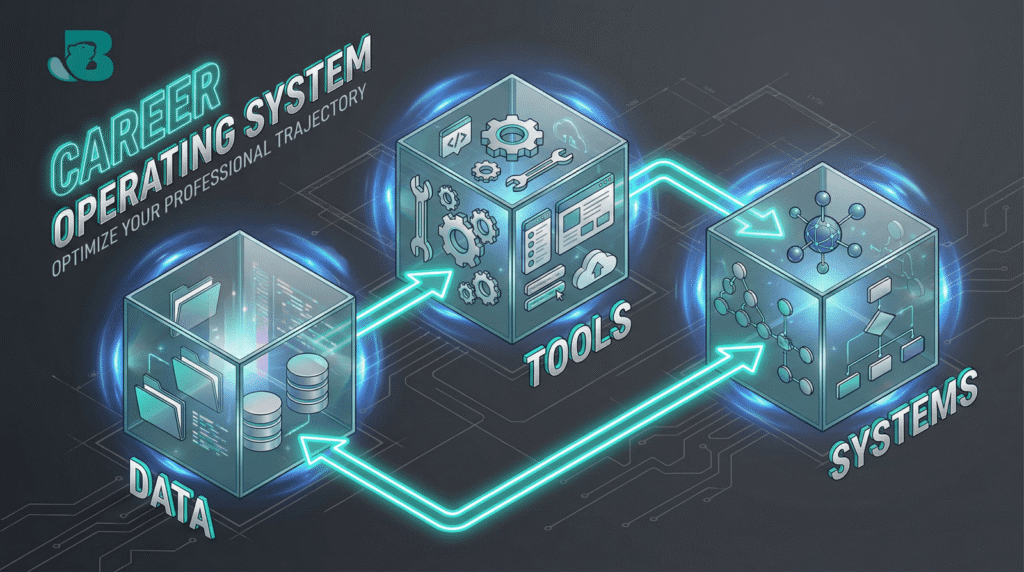
Career OS — the Career Operating System — is a different approach: viewing a career as a system that needs to be designed and operated, not just executed day by day. This system has three layers, each addressing a different dimension of the accumulation problem.
The first layer is structured data — where domain knowledge, key decisions, and lessons from each project don't disappear once the project ends. Knowledge is placed where it belongs, clearly labeled, and retrievable when needed — not stored solely in the mind of the one person who knows where everything is.
The second layer is tools that automate the repetitive — not to replace thinking, but to free attention for work that demands real judgment. Recurring reports run from templates. Onboarding processes follow standardized checklists. Common situations have ready-made responses. Each one is small — but together they create significant time for deep work.
The third layer — and the one most often neglected — is the workflow connecting long-term goals to weekly tasks. Without this layer, it's easy to fall into a state of constant busyness with no clarity about where that busyness is leading. With it, each week reveals what's truly advancing your career — and what's merely taking up space.
In biology, beavers are classified as 'ecosystem engineers' — organisms that don't merely adapt to their environment but actively restructure it. A beaver dam doesn't need the beaver's constant presence to function. It regulates water flow, creates ponds, sustains habitats — while the beaver sleeps. This is the foundational principle behind the name BEUP Space: not working more, but building things that work on your behalf.
Career OS operators aren't better than those without one because they work more. They're better because each year of work leaves behind more — a knowledge library that keeps growing, a toolkit that keeps getting refined, a thinking system that keeps deepening. Year one starts building. Year five picks up where year four left off. Year ten looks back and sees the gap clearly — not because they worked harder than everyone else, but because their architecture allowed effort to compound rather than evaporate.
The difference isn't talent or luck. It's architecture — how a person organizes their work, knowledge, and time to compound rather than merely deplete.
Building a system doesn't require a perfect plan or expensive software. It requires starting from the biggest leak — and expanding from there.
The first starting point is an audit of leakage. Questions to ask yourself: Which tasks this week had to be redone even though they were done before? What information was needed but couldn't be found immediately? Which decisions took longer than they should have because there was no clear precedent? Each answer is a specific point of intervention — not theoretical, but where time and energy are actually being lost.
The second starting point is choosing a single storage hub and committing to it. The system doesn't need to look polished from the start. It needs one place where everything important goes — instead of being scattered across email, note-taking apps, and personal memory. Once that one place stabilizes, everything else can start being built on top of it.
The third starting point is standardizing one repeating process. Just one — the most time-consuming or the most error-prone. Put it into a template. Use that template enough times for it to be tested and refined. Then move on to the second one. A system isn't built in a day — it's built one process at a time, one template at a time, one year at a time.
📌 Key Takeaways
References
— James Clear, Atomic Habits (2018)
— Tiago Forte, Building a Second Brain (2022)
— Anders Ericsson & Robert Pool, Peak: Secrets from the New Science of Expertise (2016)
— Hermann Ebbinghaus, Über das Gedächtnis (1885)

Book a free consultation to explore how BEUP can transform your workflow.
Book a ConsultationDigital Asset Ecosystem & Operating System for individuals & teams.