No products in the cart.



8 min read
This situation is more common than you think. A landlord managing fifteen, twenty rooms, with consistent monthly rent income, yet at year-end, looking back, they're still unsure how much profit they actually made.
It's not because records aren't kept. It's because the wrong things are being recorded, or the right things are recorded in a way that prevents the data from connecting into a complete picture.
Financial management for small-scale rental properties — under fifty rooms — has never been systematically taught anywhere.
People learn by trial and error, or from predecessors. But predecessors often only pass on methods sufficient for survival, not for true control.
Below are six points most landlords are overlooking. And the cost of overlooking each of them is significant.
For electricity bills, the most common way to record is: this room this month 280.000đ, that room 310.000đ. That information isn't wrong, but it's the end point of a calculation chain — not the starting point.
When you only save the monetary amount, you lose the ability to double-check. If a room consumes twice as much this month as last month, you have no basis to determine the cause.
It could be due to increased usage or an incorrect meter reading. When a tenant questions a bill, you have no data to cross-reference. When you want to observe consumption trends to detect utility leaks, the data doesn't allow you to do so.
The raw data to be saved is the meter readings — old and new — not the calculated result. From the readings, you can calculate the amount and double-check it at any time.
Money itself doesn't do anything more. This sounds simple, but it requires a different discipline of record-keeping than what most people are currently doing.
This is a common point of confusion for many landlords regarding the financial health of their rental properties, especially during periods with many new tenants moving in — or conversely, when many tenants move out simultaneously.
Security deposits are typically equal to one to two months' rent. Landlords receive them upon signing the contract. However, from an accounting perspective, it's an amount you're holding on behalf of the tenant.
They must be returned when tenants leave, unless there are legitimate deductions. What happens if you don't separate security deposits from revenue? You'll have months that look very “good” when many new contracts are signed, and months that look very “bad” when many tenants move out and you refund deposits — even though the actual business performance hasn't significantly changed.
A simple rule: security deposits should have their own separate column and row, and never be included in the total monthly revenue report. Only when you deduct from or process a deposit does an actual accounting entry arise that truly affects profit.
Most simple payment tracking systems only record the status for each month: paid or unpaid. This method has a serious flaw — it doesn't show you the total outstanding debt accumulating over time.
In reality, a tenant owing two months' rent and a tenant owing one month's rent will look the same on an “unpaid this month” list.
Only when you track each tenant's cumulative outstanding balance — that is, the total amount they currently owe — will you see the true extent of the problem.
Practical experience shows that in most cases, landlords discover tenants owing multiple months' rent not because tenants are intentionally defaulting, but because neither party has a clear tracking system.
A good accounts receivable ledger should automatically update the remaining balance after each payment is recorded, and should provide automatic alerts when an amount is more than 30 days overdue.
A vacant room doesn't incur utility costs, doesn't have troublesome tenants, and on the surface, appears neutral. However, in rental property financial management, a vacant room is a real cost — the opportunity cost of uncollected rent.
The occupancy rate — the fill rate — is one of the most crucial metrics that most small-scale landlords fail to track.
If you have twenty rooms, each renting for 3 million per month, and an average of two rooms are vacant each month, you are “losing” 6 million per month — 72 million per year — without any figures on your records reflecting that.
Tracking your monthly occupancy rate, along with the average number of days a room remains vacant before a new tenant moves in, helps you assess the true performance of your property and detect early if a specific room type is experiencing issues with its rentability.
In professional rental property management, the common rule is to contact tenants at least 45 to 60 days before their contract expires to confirm their intention to renew.
This gives you enough time to prepare to find new tenants if they don't continue, and avoids vacancies during the transition period.
Most small-scale landlords cannot do this because they lack an automated reminder system.
When contracts are stored on paper or in a phone, there's no way to know which rooms require proactive attention next month without manually checking each contract. A well-organized contract list should automatically flag contracts expiring within the next 30 to 45 days.
A room renting for 3 million per month might seem quite profitable.
But if, over the year, there are two wall repaints, one lock replacement, one AC repair, and one water heater replacement — total maintenance costs could reach 4 to 6 million for a single room, effectively eating up two months of profit without any line item in your monthly tracking reflecting it.
A common practice in professional rental property management is to allocate 5 to 10% of monthly rental revenue into a maintenance reserve fund — even if no expenses are incurred that month.
This approach helps ensure actual profits are more accurately reflected in monthly reports and prevents situations where a month with sudden large expenses appears to be a loss-making month.
For properties with fewer than 50 rooms, a properly designed Excel spreadsheet can handle everything mentioned above.
Điều kiện quan trọng là “thiết kế đúng”: các bảng tính phải liên kết với nhau, nhập liệu một chỗ thì các chỗ còn lại tự cập nhật, và không có công thức nào cần bạn copy thủ công từ tháng này sang tháng khác.
Dedicated property management software typically starts to show clear advantages when the scale exceeds 50 rooms, when managing multiple locations, integrating automatic payment gateways, or requiring accounting-standard reports for tax and audit purposes.
Below that threshold, the cost of learning and operating the software often outweighs the benefits it provides compared to a well-built file.
PRACTICAL TOOLS
Complete Rental Property Management System — Excel Template
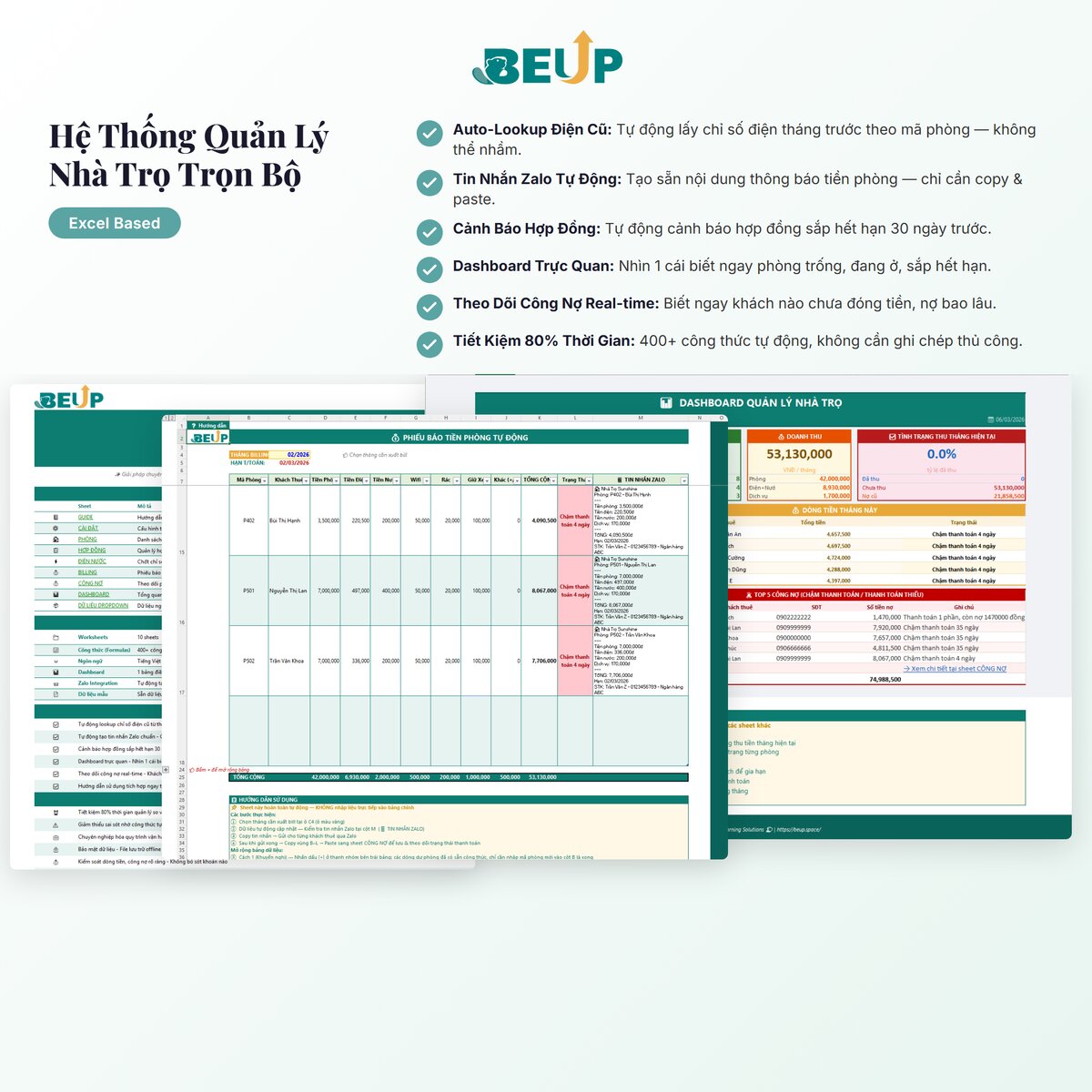
10 automatically linked spreadsheets — utilities (meter readings, not monetary values), deposit separation, cumulative outstanding balances, contract expiration alerts, and a monthly dashboard. Designed according to the principles in this article. Runs on Excel and Google Sheets, no additional installation required.
Five essential metrics to track: total actual rental revenue (excluding deposits), total outstanding receivables, occupancy rate, incurred maintenance costs, and the number of contracts expiring in the next 30 days.
These five figures provide you with sufficient information to make monthly decisions without needing lengthy reports.
When grouped together, you lose the ability to review each item individually in case of disputes, cannot analyze electricity and water consumption trends over time, and cannot separate actual operating costs from net revenue.
Each revenue item needs its own line with a clear origin.
The first step is to standardize your list of rooms and contracts — room name, current tenant, move-in date, expiration date, rent price, and deposit held.
This is the foundational data that everything else will rely on. Once this list is accurate, tracking utilities and receivables will be much easier to build upon than starting with the complex parts.

Book a free consultation to explore how BEUP can transform your workflow.
Book a ConsultationDigital Asset Ecosystem & Operating System for individuals & teams.