No products in the cart.



4 min read
Most failures in implementing AI operations stem from a common source: applying the right tool to the wrong problem — and then concluding that the tool is the problem.
When an organization considers introducing AI into its operations, the question often asked is: "Can AI do this?"
That's the wrong question.
With enough prompt engineering, enough RAG, enough fine-tuning — AI can "do" almost anything to some degree. A more accurate question is:
What is currently being used to do this task? Where is the real bottleneck? And will introducing AI solve that bottleneck?
The gap between these two questions is the boundary between deployments that create value — and those that only add complexity.
Each item below is an evaluation angle. Click to see details.
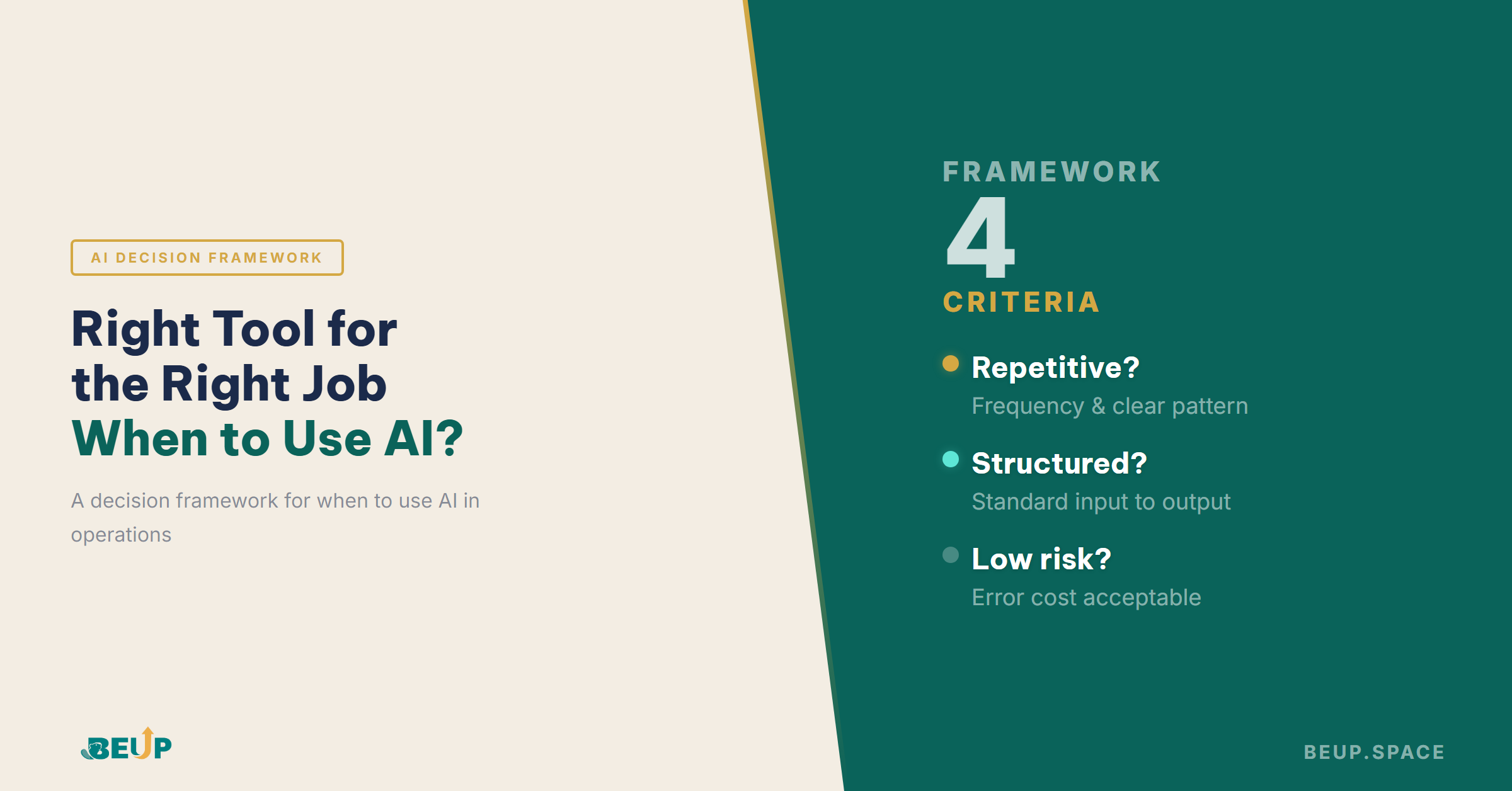
Start by looking at the current situation — who or what is handling this process.
Data is structured, logic is clear, and output is predictable. Introducing AI at this point only adds an extra layer of "guessing" to a system that is already running accurately — at a higher cost and lower reliability.
No need for AI
Especially tasks that require reading and understanding natural language, making judgments from disorganized information, or handling hundreds of exceptions that can't be written into rules. AI can do this on a larger scale, cheaper, and at an acceptable quality level.
AI has an advantage
Analyzing all customer feedback every week, compiling reports from multiple disparate sources, continuously monitoring to detect anomalies... This is where AI creates entirely new value — not replacing anyone, but doing what was previously impossible.
AI creates new value
The nature of the information in the decision-making process determines which tool is suitable.
Numbers, status, categories, logical conditions. If you can write a full specification for every input/output, software handles it better than AI: faster, cheaper, and verifiable.
Software is more suitable
Natural language, unstructured text, images, sound — or cases where meaning changes depending on context. This is where rule-based systems fall short, and AI has a natural advantage.
AI's sweet spot
Most real-world processes are a mix of both. The structured part can be handled by software. The question is: is the unstructured part large enough and painful enough to be worth investing in?
This is the angle most often overlooked when planning, but has the greatest impact on how the system is designed.
AI is not 100% accurate — that's its nature. The question isn't 'Will AI be wrong?' but “what happens when it goes wrong?”
Misclassifying emails, suggesting non-standard content, summarizing with missing points. Quick detection, easy fix — high tolerance for error.
AI is suitable
Incorrect invoicing, mistaken financial transactions, wrong compliance decisions. It’s not that AI is inadequate — but the inherent risk of the task doesn’t match the probabilistic tool.
Human review is needed
Choose the most suitable answer for each step. Results will appear below.
Click to select an answer to proceed
Tools aren't at fault when misapplied. But the organization bears the consequences when that happens.
AI operates best not when it does the most — but when it's placed correctly within a system that understands its own limitations.
Next article in the series
How to design a hybrid architecture — when to let software handle it, when to let AI handle it, and how to make both work together without creating blind spots in operations.
Get insights on management, operations & digital assets delivered to your inbox.

Copyright © 2026 BEUP Learning Solutions
MST: 3301755602
Book a free consultation to explore how BEUP can transform your workflow.
Book a Consultation →Digital Asset Ecosystem & Operating System for individuals & teams.